 Our use of cookies
What is a business WAN and who can join it?
Business WANs unify an organisation’s office networks, remote devices, cloud services and data centres into a single managed network, delivering higher performance and coherent security across the entire estate.
This guide explains what a business WAN is, who can join one, how it works, the technologies behind it, and the common types.
Contents:
- What is a business WAN?
- How does a wide area network (WAN) work?
- Types of WAN: private, public and hybrid networks
What is a business WAN?
A business WAN (wide area network) connects, prioritises and secures an organisation’s traffic, linking office networks, data centres, users and cloud resources across various locations.
It encompasses various software and hardware technologies layered on top of a mix of private and public infrastructure, reserving bandwidth for the business, optimising routing, enforcing access controls, centralising management, and more.
Unlike a business local area network (LAN), which operates at a smaller scale, or a public wide area network such as the internet, a business WAN’s configuration and access is controlled entirely by the organisation.
Who can join a business WAN?
Users, devices, sites, cloud resources and approved third parties can all connect to a business WAN, with access governed by the organisation’s network and identity policies.
For example, a visitor might get only basic internet access through guest WiFi, a cloud app’s API might be limited to specific users and resources, and a local admin might hold privileges solely for managing their own site’s network.
The most common joiners include:
- Office locations: Head office, branch sites and regional hubs.
- Remote and mobile staff: Employees working from home or on the move.
- End-user devices: Laptops, tablets, desk phones and VoIP handsets.
- Servers and storage: Equipment hosted in company-owned or rented data centres.
- Cloud services: Applications and workloads hosted with cloud providers.
- Operational technology: Point-of-sale terminals, CCTV, printers and IoT sensors.
- Trusted third parties: Suppliers, contractors or partners granted controlled access.
In every case, the WAN’s identity security platform authenticates the joiner first, then applies policy to determine what they can reach.
How does a wide area network (WAN) work?
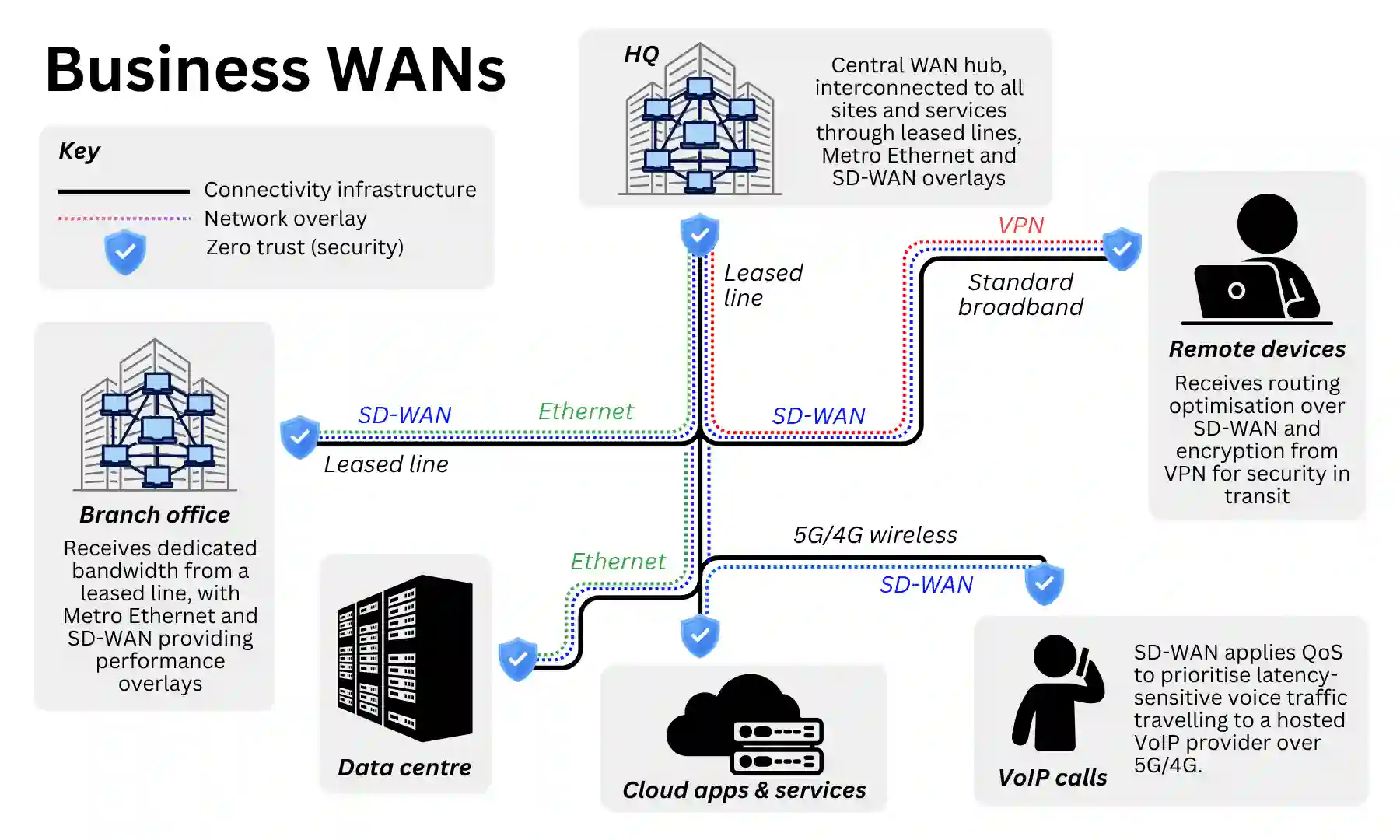
A WAN interconnects locations, users, and cloud services, directing traffic intelligently between them and applying consistent security, access control and management across the entire network.
These three functions rely on various WAN technologies that act in concert to deliver a secure and performant WAN:
Connectivity
The underlying transport layer of the WAN comprises the physical and logical links that carry traffic between every site, user and service. Various technologies are combined to balance reach, capacity and resilience:
- Physical links: The underlying cables and wireless transmissions that move data between locations and users. Can be shared internet circuits (e.g. full fibre business broadband) or dedicated private connections (e.g., leased line business broadband).
- Logical links: Software-defined connections, such as encrypted tunnels (e.g., VPNs) and virtual circuits (e.g., Business Ethernet), established over the physical infrastructure to provide private, structured pathways between sites and users.
- Edge devices: The network switches, routers and firewalls at each location that act as data on-ramps to connect users and sites to the wider network.
The outcome is a flexible mesh of connections capable of reaching every part of the organisation’s digital estate, regardless of where it is located.
Performance
Aside from basic connectivity, the WAN ensures that traffic moves efficiently across those links. This is the intelligence layer, responsible for how data is routed, prioritised and protected against disruption:
- Routing and path selection: Solutions like SD-WAN and SASE that continuously determine the optimal route for each traffic type based on real-time network conditions, application requirements and cost.
- Traffic prioritisation: QoS allocates bandwidth and priority to time-sensitive applications such as voice and video, ensuring critical traffic is unaffected by periods of congestion.
- Resilience and failover: Detects degraded or failed links and automatically reroutes or load balances traffic across alternative paths, maintaining service continuity without manual intervention.
Collectively, these mechanisms maintain the performance and reliability of business-critical applications as network conditions fluctuate.
Security and management
A WAN also centralised its control layer, aiming to act as a single, consistent environment rather than a series of independently managed sites. This centralisation includes both management and security, where protection is applied uniformly across every connection, user and service:
- Perimeter security: Firewalls and gateways defend the boundaries of the network, inspecting and filtering traffic entering or leaving each site or cloud environment. Next Generation Firewalls (NGFWs) go a step further with deep packet inspection.
- Zero trust security: Authenticates and authorises every user and device before granting access to specific resources, irrespective of their location or network of origin. It’s the main execution point of organisation-wide identity security.
- Centralised policy and monitoring: Enables IT teams to define security and access rules once and enforce them consistently, with end-to-end visibility into traffic, performance (i.e., network monitoring) and threats (i.e., SIEM).
Together, these controls transform the WAN from a set of connections into a managed, secure environment that the organisation can operate as a unified system.
Types of WAN: private, public and hybrid networks
While every organisation tailors its WAN to suit its own use case, WANs can broadly fall into three categories:
- Private WAN: A network built on dedicated infrastructure such as leased lines, MPLS or dark fibre, typically leased from a provider and kept logically separate from the public internet. Dedicated bandwidth usually translates to the highest performance, predictability and security.
- Public WAN: The internet itself, i.e., the globally shared network of networks open to anyone, which businesses use both for general connectivity and as a transport layer for other services such as VPNs and SaaS access through DNS and BGP.
- Hybrid WAN: A combination of private infrastructure and the public internet, usually orchestrated through business SD-WAN solutions that route each type of traffic over the most appropriate path. This is the most common model for modern businesses, balancing the control of private connectivity with the reach and flexibility of the public internet.
Business WAN FAQs
Our business networking experts answer commonly asked questions regarding business WANs:
Do small businesses need a WAN?
In practice, most small businesses already operate a WAN. Any business with remote workers, cloud applications or more than one internet connection is already running a small WAN, whether it calls it that or not. The relevant question is how formally it should be designed, managed and secured.
How much does a business WAN cost?
It depends on the number of sites, connectivity types, performance requirements and whether the WAN is self-managed or delivered as a service.
A small business using broadband and VPN can run a basic WAN for a few hundred pounds per month, while an enterprise combining leased lines, SD-WAN and managed security can spend tens of thousands.
The main cost drivers are connectivity, hardware, software licensing and ongoing management.
Is SD-WAN replacing traditional WANs?
Yes, SD-WAN is a disruptive WAN technology. It has already overtaken MPLS as the default model for modern private WANs, though MPLS remains in use for performance-sensitive traffic between fixed sites. The most common outcome is a hybrid model in which SD-WAN orchestrates traffic across both private and public links.
Is a private WAN more secure than an internet-based WAN?
By default, yes. Private WAN traffic never traverses the public internet, which removes a large class of external threats.
That said, a well-configured internet-based WAN using encryption, segmentation, and zero trust access can achieve a comparable security posture for most use cases. The choice usually comes down to risk tolerance, regulatory requirements (e.g., GDPR, ISO 27001) and budget rather than security alone.
What is a managed WAN service?
A WAN that a third-party provider designs, deploys and operates on behalf of the organisation, including connectivity, hardware, monitoring and ongoing support. Commonly referred to as Cloud Managed WAN services.
It allows businesses to access enterprise-grade networking without the in-house expertise or operational capacity to run it themselves. Managed services range from connectivity-only arrangements to fully outsourced WAN environments.
What is a WAN router?
A WAN router is another name for any business-grade broadband router which connects a local area network to the internet and other WANs. WAN routers are generally provided by business broadband providers.
 Back to blog