 Our use of cookies
VoIP call recording: How it works and best practices
VoIP call recording is one of the most regulated and operationally significant features of a modern business phone system.
This guide covers how it works, the technology behind it, the types of recording available, the legal framework that governs it, and the best practices businesses should have in place to stay compliant and get the most from it.
Contents:
- What is VoIP call recording?
- How VoIP call recording works
- Choosing between hosted and on-premises call recording
- Types of VoIP call recording
- Why businesses record VoIP calls
What is VoIP call recording?
VoIP call recording is the capability of capturing and storing audio conversations made over a business VoIP phone system.
It is more scalable, manageable and user-friendly than recording on traditional business phone lines (landlines) because it is software-based, and does not typically require dedicated on-site hardware.
VoIP call recording is a standard feature available in most modern VoIP platforms, though the level of functionality, such as storage limits, access controls, or automatic recording rules, varies by provider and plan.
Because call recordings contain personal data, they are subject to strict data protection laws and a range of sector-specific regulations.
How VoIP call recording works
VoIP call recording works by capturing the call’s audio stream at an appropriate point in the call path, then processing and saving it as an audio file that can be accessed and managed through the system’s admin portal.
Here is how it works step-by-step:
- Recording is triggered: Recording is initiated manually by a participant during a live call, or set to start automatically for all calls or specific call types, based on rules configured in advance by an administrator.
- Audio is captured from the call path: As the call takes place, the recording software intercepts voice data packets. Depending on the architecture, audio may be captured at the PBX, SIP trunk, media server, session border controller, endpoint, or a dedicated recording layer.
- The media is processed and encoded: Captured packets are reassembled in the correct order and encoded into an audio file. Where supported, each party’s audio is recorded on a separate channel (known as dual-channel recording) which is important for cybersecurity compliance, speech analytics, and dispute resolution.
- Metadata and policy controls are applied: Retention schedules, compliance flags, and access permissions are attached to the recording based on the business’s configured policies.
- The recording is stored securely: The file is saved either in the provider’s cloud infrastructure or within the business’s own environment in on-premises or hybrid deployments.
- The file is surfaced for playback, search, retention, and audit: The recording becomes available through an admin portal, where it can be played back, searched, downloaded, shared or archived according to the business’s retention policies.
The technical components that underpin this process, including encoding formats, storage infrastructure, APIs, and VoIP analytics, are covered in more detail below.
The technology behind VoIP call recording
VoIP call recording involves a stack of components working together at different layers, from the software that captures audio to the infrastructure that stores and surfaces it. These can be divided into core components, capabilities, and VoIP security controls.
To learn more about the fundamentals of VoIP technology, see our what is VoIP guide:
Components
The underlying infrastructure that makes recording possible:
- Recording engine: The core software that initiates, captures, and terminates recordings. In hosted VoIP systems, the recording function usually runs in the provider’s cloud. In on-premises deployments, it may run on the PBX, a dedicated recording server, an appliance, or virtualised local infrastructure.
- Storage platform: Cloud storage is standard for hosted VoIP systems, while on-premise storage is used in regulated environments requiring data residency control.
- Network switches: Used in on-premises VoIP to link desk phones (audio capture), VoIP server (call recording engine), and storage (stores call recordings) together, and define the VoIP-specific VLAN in which voice calls are carried.
Capabilities
What the system does with the captured audio data:
- Audio processing and encoding: Captured audio is encoded into WAV (Waveform Audio File Format at 500KB per minute) for high quality, or MP3 (60KB per minute) for compressed storage. The format choice depends on whether storage efficiency or audio fidelity is the priority.
- Call metadata: Recordings are indexed by call metadata, including date, time, caller, duration, and agent, enabling efficient search and retrieval. This is stored alongside each audio file.
- Management and retrieval portal: A web-based interface for searching, playing, downloading, annotating, and managing recordings.
- Recording API: Enables VoIP integration capabilities with CRM platforms for automatic attachment of recordings to customer records, feeds into cybersecurity compliance platforms, and supports custom workflow automation.
- Speech analytics: AI-powered analysis of recording content, including keyword detection, sentiment analysis, silence patterns, automatic quality scoring, and compliance breach flagging. This enables VoIP monitoring at scale without manual review and is increasingly available on standard hosted platforms.
- Retention automation: Retention policies can be enforced programmatically, with recordings automatically flagged for deletion once their defined retention period expires. This reduces the risk of holding data longer than necessary.
- Legal hold: Where recordings may be relevant to litigation, regulatory investigation, or a subject access request, legal hold mechanisms allow specific files to be exempted from automated deletion and locked against modification until the hold is lifted.
Security controls
How recordings are protected, governed, and kept tamper-proof throughout their lifecycle:
- Encryption: Recordings are protected both in transit and at rest. TLS 1.2 or 1.3 secures audio packets and metadata as they travel across the network; AES-256 is standard for stored files. In cloud deployments encryption is typically managed by the business VoIP system provider; in on-premises environments it falls to the business to configure and maintain.
- Access controls and authentication: Access is governed by role-based permissions, ensuring agents, supervisors, compliance officers, and administrators can only access what their role requires. SSO, MFA and PAM are available on most enterprise-grade platforms.
- Tamper-evident audit trails: Every access event (playback, download, annotation, deletion) is logged with a timestamp and user identity. Some platforms also apply cryptographic hashing at the point of capture, making any subsequent modification detectable.
Choosing between hosted and on-premises call recording
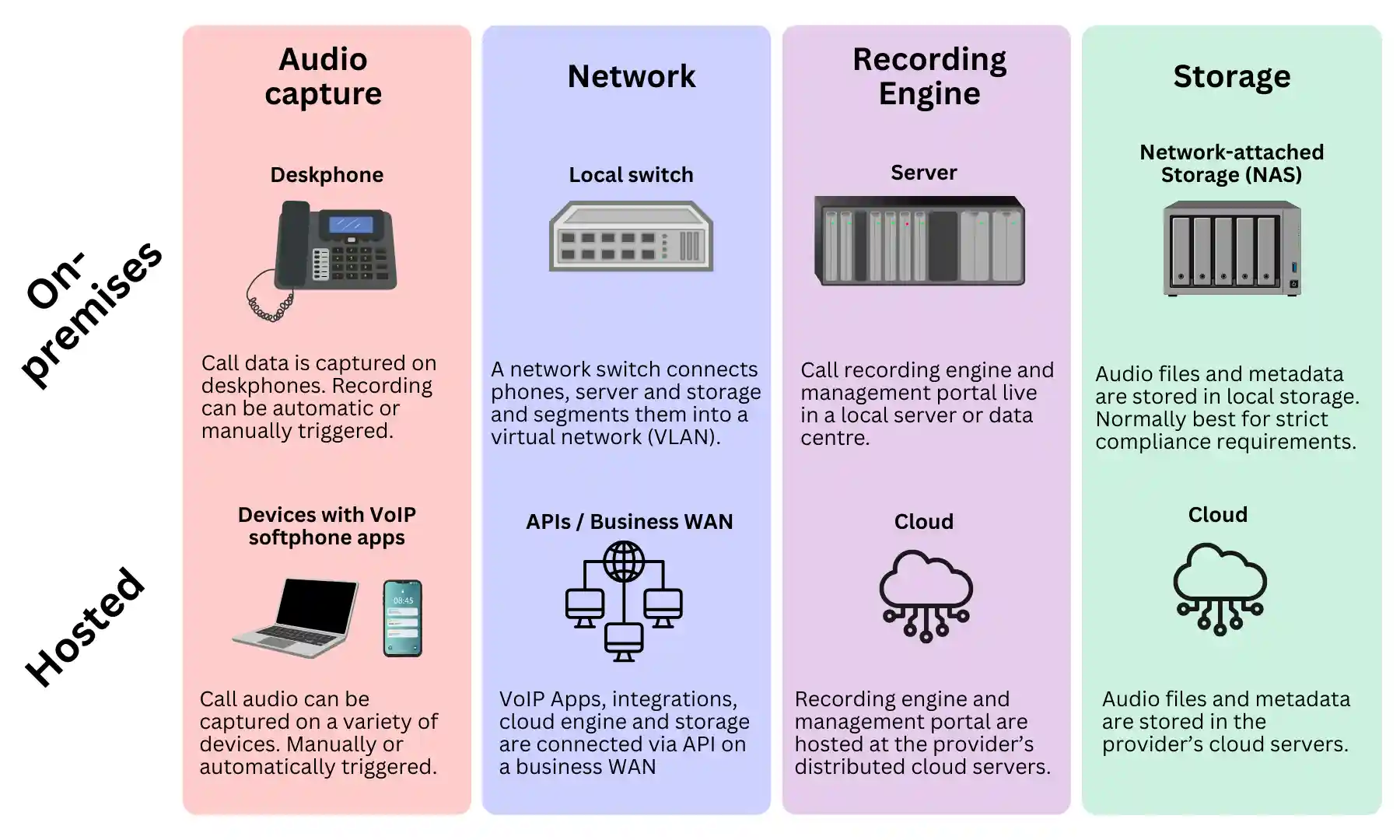
The choice between on-premises and cloud-hosted recording affects where the recording engine runs, where audio files are stored, how responsibility for management, security, and compliance is shared.
For most businesses:
- On-premises deployments give businesses direct control over their data; best for organisations with strict data residency or regulatory requirements. However, VoIP phone installation leads to higher business VoIP phone costs.
- Hosted recording is the simpler and more cost-effective option, with infrastructure managed entirely by the provider. It is more flexible, with recording available on remote VoIP devices.
The diagram below summarises the key differences:
Types of VoIP call recording
VoIP call recording falls into three broad categories: How recording is triggered, what controls are available during a call, and how the recording is technically captured.
Recording modes
Admins choose the mode depending on how calls are captured:
- On-demand (manual): A participant manually starts and stops recording during a live call. The most common approach among SMEs using VoIP for general business purposes, where recording is discretionary rather than required.
- Always-on (automatic): Every call is recorded automatically without exception or manual intervention. Standard in regulated industries and increasingly adopted by larger enterprises seeking comprehensive audit trails.
- Selective (rule-based): Recording is triggered automatically by predefined rules, such as specific departments, phone numbers, call durations, or time of day. Common in mid-market businesses with sales or customer service teams that want consistent quality sampling without recording every call.
Control features
These are VoIP features that give businesses more granular control over what is captured during a call:
- Pause and resume: Temporarily pauses capture mid-call, typically when a customer is providing sensitive information such as payment card details. Most platforms support this natively alongside always-on recording.
- Screen recording: Captures the agent’s computer screen alongside audio. Frequently used in contact centre environments for VoIP call quality assurance and fraud prevention.
Recording architecture
The underlying approach that determines how recording interacts with the call itself:
- Active recording: Recording takes place at the VoIP platform level, meaning the system initiates, manages, and terminates capture directly. This is the standard approach for the vast majority of business VoIP deployments and underpins all three recording modes.
- Passive recording: Captures voice traffic at the network level without interacting with the call flow, meaning the VoIP system is unaware that recording is taking place. Preferred in compliance-heavy environments such as financial services, where recording must be provably independent of the system it records.
Why businesses record VoIP calls
This section summarises the key reasons businesses in the UK commonly use VoIP recording.
Mandatory recording
In certain industries, call recording is a defined legal or regulatory requirement. The clearest example in the UK is financial services, where FCA SYSC 10A mandates always-on recording for investment firms, banks, and stockbrokers dealing in MiFID-scope instruments.
Other sectors face specific obligations too, though these vary significantly in scope and specificity. For a full breakdown of the legal and compliance framework, see our VoIP recording compliance section.
Discretionary recording
Call recording may also be adopted where it adds operational value. The recording type and setup can be tailored to the specific business use case:
- Quality assurance and staff training: Recording may be part of systematic reviews of call handling for performance management, onboarding, and skills development. Selective or on-demand recording is usually sufficient for this purpose.
- Dispute resolution and evidence: A recording provides an objective record of what was agreed, protecting both the business and the customer. Call recordings are admissible in UK civil proceedings and regulatory investigations. This is particularly common in financial services, professional services, and B2B transactions where the terms of an agreement may later be disputed.
- Customer experience improvement: Recordings can be reviewed manually or via speech analytics to identify complaints, recurring issues, and process failures, feeding into service and operational improvements.
UK legal and compliance framework for call recording
Call recording is subject to legal and regulatory scrutiny because it involves handling personal data and, in some cases, commercially sensitive or special-category information. The level of scrutiny depends on the industry and the nature of the calls being recorded.
The following are the rules and regulations that apply to UK organisations and why:
UK GDPR (Data Protection Act 2018)
Applies to: All UK businesses that record calls.
Call recordings contain personal data, meaning UK GDPR applies universally. This has three practical consequences for all organisations recording calls.
- A lawful basis is required before recording: Most businesses rely on legitimate interests, which requires a documented Legitimate Interests Assessment (LIA). FCA-regulated firms are covered automatically, as recording is a legal obligation for them.
- Callers and employees must be informed: Call recording must be disclosed in the business’s privacy notice. Employees must also be told their calls may be recorded, typically through their employment contract and staff handbook.
- Individuals can request their recordings: Anyone can submit a Data Subject Access Request (DSAR) to obtain a copy of any recording in which they feature. The business must respond within one month and must redact any personal data relating to third parties before sharing.
Non-compliance can result in ICO (Information Commissioner’s Office) fines of up to £17.5 million or 4% of global annual turnover.
Ofcom general conditions
Applies to: All businesses that record telephone calls made or received in the UK.
Under the Ofcom General Conditions, any business that records calls must play an automated announcement informing callers that the call is being recorded before it begins.
The obligation is to inform the caller, not to obtain consent. A caller who continues after the announcement is considered to have accepted.
If a caller objects, the business must stop recording or offer an alternative contact method. Ofcom can take enforcement action against businesses that fail to meet these notification requirements, including issuing formal directions and financial penalties.
Industry-specific regulations
For businesses in the financial sector or those that accept verbal payment card details over the phone, the following also apply:
FCA SYSC 10A
This regulation is specific for Investment firms, banks, and stockbrokers dealing in MiFID (Markets in Financial Instruments Directive) scope instruments.
FCA SYSC 10A mandates always-on recording of all relevant communications (including internal ones), a minimum five-year retention period, and storage in a non-rewriteable format. There is no opt-out, and the FCA can impose fines and public censure for failures.
PCI DSS (Payment Card Industry Data Security Standard)
This one applies to any business that accepts verbal payment card details over the phone.
It mandates that card numbers, expiry dates, and CVV codes must not be recorded. Recording has to be paused before the customer reads out their details and resumes afterwards.
Most modern VoIP platforms handle this natively with a pause-and-resume function. Non-compliance can mean fines, higher transaction fees, or losing the ability to process card payments altogether.
Best practices for VoIP call recording
Call recording carries significant regulatory, legal, and security implications, making it an area where businesses cannot afford to be ad hoc. The key practices to have in place are:
- Written call recording policy: Document why calls are recorded, which calls are captured, retention periods, access permissions, security measures, and how Data Subject Access Requests (DSARs) are handled. Without a written policy, businesses have no defensible position in the event of a regulatory investigation or dispute.
- Inform all parties: Callers hear an automated announcement before recording begins, employees consent via employment contract, staff handbook, and written policy. Failure to inform is a UK GDPR breach regardless of whether the recording itself is lawful.
- Role-based access controls (RBAC): Restrict access to those with a legitimate need, limit download and export permissions, and log every access event in an audit trail. Uncontrolled access to recordings is both a data protection risk and a potential source of liability.
- Encrypt recordings: Confirm whether encryption keys are provider-managed or business-managed, as this determines who can ultimately access your recordings.
- Define and enforce retention periods: Five years minimum for FCA firms, 90 days to one year for general quality assurance, one to three years for dispute resolution. Retaining recordings longer than necessary is itself a GDPR violation. Automate deletion processes and document them.
- Pause for payment data: Pause before the customer provides card number, expiry, or CVV code. Recording this data is a PCI DSS (Payment Card Industry Data Security Standard) violation. Build it into the payment process as a routine step rather than leaving it to individual discretion.
- Regular compliance reviews: Audit recording coverage, retention, access logs, and policy currency periodically. For FCA firms, this is part of the compliance monitoring programme. For all others, it is the only reliable way to catch configuration drift or policy gaps before they become regulatory exposure.
 Back to blog