 Our use of cookies
AI voice agents and how they work for business calls
AI voice agents are LLM-based bots that make and answer calls on behalf of a business, holding natural conversations like a human agent would.
They can handle multiple calls simultaneously and are good at simple tasks, but they continue to rely on backup human agents when unable to handle requests.
This guide covers how they work, why businesses are adopting them, and the key considerations for deploying them successfully.
Jump to:
- What is an AI voice agent?
- How do AI voice agents work?
- How AI voice agents fit into business phone systems
- Why do businesses use AI voice agents?
What is an AI voice agent?
An AI voice agent is software that can hold a “real”, spoken phone conversation with a person. It listens, works out what the caller wants, fetches or does something, and replies out loud in near real-time.
It combines real-time speech recognition, a large language model (LLM), and voice synthesis to handle multi-turn dialogue without a human on the line.
Inbound calls are routed to it in the same way they would be to a human agent, typically after the caller has passed through a simple auto-attendant (for example, “press 1 for sales”) or a more complex IVR.
It is significantly cheaper than a human agent on a per call basis and effective on high-volume, repetitive calls, such as customer support FAQs, order and delivery status, and appointment booking.
However, its limitations and risks mean it still needs careful deployment, with a human agent alongside to handle the more difficult calls.
How do AI voice agents work?
An AI voice agent runs the same quick loop on every turn of a call. It listens, works out what the caller needs, takes action to fetch it, and replies, ideally in under a second.
Here is a summary of each step:
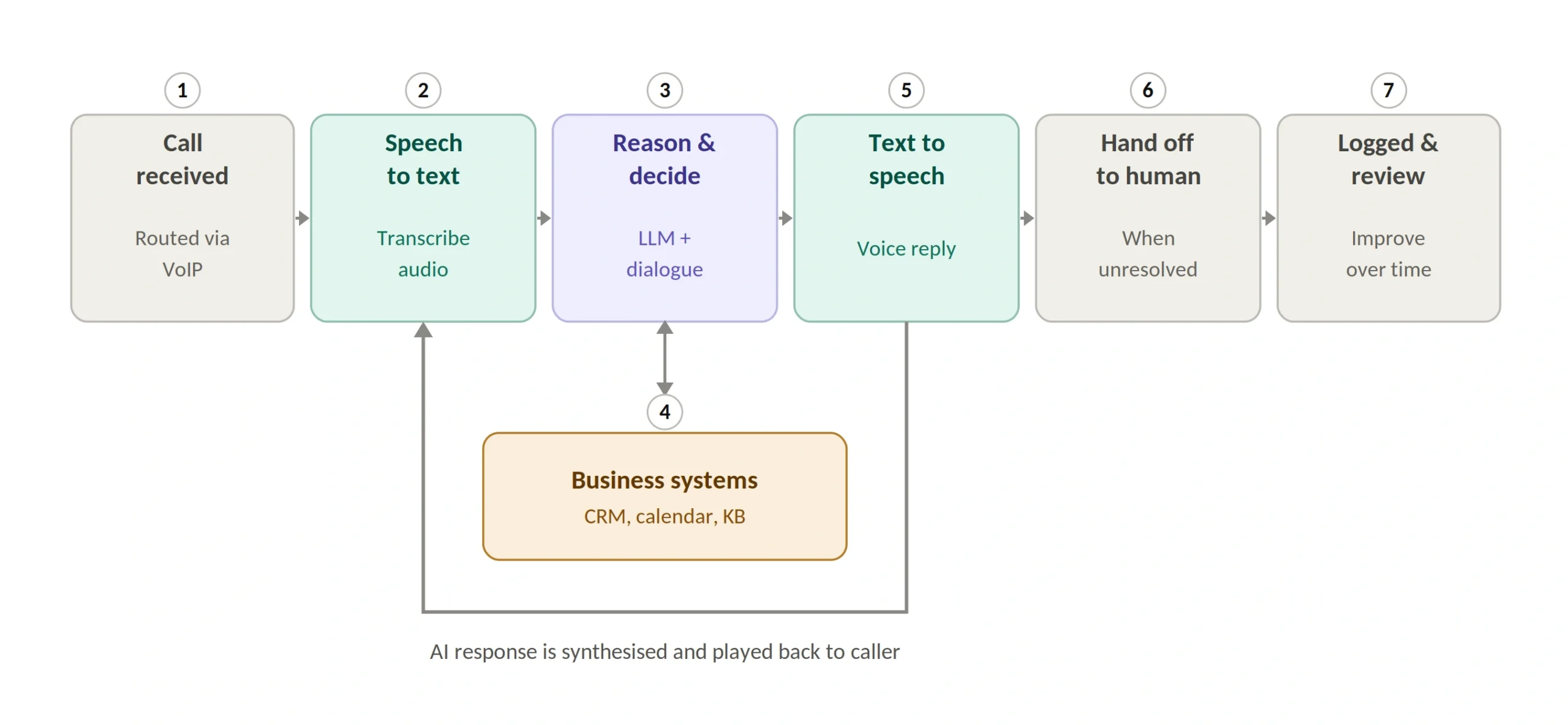
1. A call is received and routed to the agent
When a customer dials the business number, the call first passes through the company’s existing business VoIP phone system and follows the configured call logic.
Typically, callers should expect to be received by a quick auto attendant and wait for a short moment in a call queue before the call is passed to the AI voice agent.
2. The caller’s speech becomes text
Once the call reaches the agent, the caller’s voice needs to be translated into text through speech to text for the AI to understand.
A speech recognition engine transcribes the caller live as they speak, working in small chunks rather than waiting for them to finish.
Accuracy matters a great deal at this stage because any mistake carries through the rest of the call. If “cancel my renewal” is heard as “extend my renewal”, the agent will confidently solve the wrong problem.
To avoid that, the system is taught the company’s names, product terms, and jargon so it picks them up correctly, and usually confirms its action before undertaking it.
3. The agent works out what the caller wants
The transcribed text then goes to a large language model (LLM) optimised for quick responses over raw power.
Most agents run on fast, responsive models such as OpenAI’s GPT-4.1 or Google’s Gemini Flash because they reply almost instantly while still following instructions well.
Whichever model is used, the LLM does three things:
- Understands intent: It catches the real goal behind the words, not just keywords.
- Remembers context: It tracks what was said earlier, so the caller does not have to repeat information or instructions.
- Decides what to do: It answers, asks a follow-up, looks something up, or escalates.
4. The agent connects to business systems to act
In order for language models to resolve a call that requires data from a client database, it needs to connect to the company’s systems and integrations, typically through an API.
Typical systems that the LLM will fetch information from include:
- CRMs: Identify the caller and pull up their account and history to respond.
- Booking systems: Check live availability and book, reschedule, or cancel bookings.
- Knowledge base: Retrieves approved answers, forcing it to give fixed, deterministic answers to avoid the risk of giving false information.
- Orders and tickets: Look up the status or raise a ticket.
The tools are deliberately scoped. Low-risk actions like a lookup or booking run automatically, while higher-risk ones like a refund are gated behind human approval.
5. The reply becomes speech
Once the LLM deems it has gathered all the necessary information or taken action, it writes its answer, and a text-to-speech engine turns it into a natural voice that plays back to the caller.
Then the loop back to listening to the caller (2) starts again.
Aside from accuracy, speed is regarded as a critical factor for high caller satisfaction, as people expect a reply in under a second, and any longer feels like the line has dropped, so the agent starts working before the caller even finishes talking.
6. Call hand offs to a human when needed
When the agent detects frustration in the caller’s voice or cannot resolve the issue, it is typically configured to transfer the call to a human.
Some transfers are initiated by the model through a dedicated transfer tool, while others are driven by background checks monitoring for frustration, low confidence, an explicit request for a person, or repeated failures.
The full transcript, caller details, and a summary are passed to the receiving agent to attempt a smooth handoff.
7. The call is logged and used to improve
Every call is transcribed and recorded to give teams a chance to improve the agent. Typically, calls flagged by performance metrics, such as those escalated, abandoned, or poorly scored, are used to refine prompts, flows, and vocabulary.
The idea, in theory, is that over successive review cycles, the agent increasingly provides a better service.
How do AI voice agents differ from IVR, chatbots and virtual receptionists?
An AI voice agent is the AI counterpart of a human agent, the layer that actually holds the call and resolves it.
The technologies around it, the auto-attendant, IVR, chatbot, and virtual receptionist, are not rivals but other layers of the same call, and each is now being reshaped by AI in its own way:
| Technology | What it does | How it relates to an AI voice agent |
|---|---|---|
| Auto attendant | Greets callers and routes them, using a fixed menu | The front door that passes calls through to the agent. Increasingly conversational rather than menu-based |
| IVR | Menu-driven self-service for simple, fixed tasks such as balance checks | Often sits in front of the agent and hands the call over. AI is turning its rigid menus into natural-language "conversational IVR" |
| Chatbot | Holds the same kind of AI conversation, but in text on digital channels | A sibling to the voice agent, covering web and chat while it covers the phone |
| Virtual receptionist | A person handling front-of-house calls, often remotely through a call answering service | The human role the agent automates for routine calls, with people kept for what needs them |
How AI voice agents fit into business phone systems
In many ways, an AI voice agent fits into a phone system in the same place a human agent would.
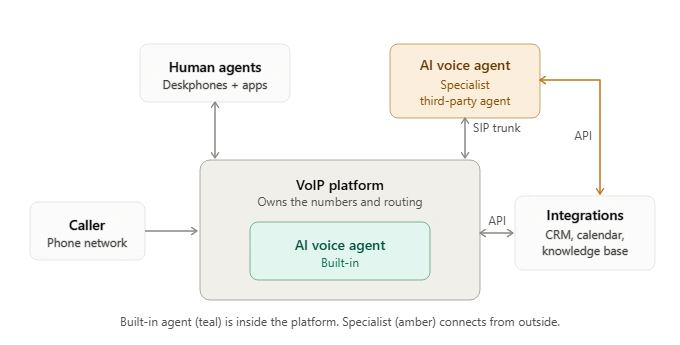
The VoIP platform still owns the numbers and the routing, and when its logic decides a call should go to the agent, it connects the call through just as it would ring a human’s extension.
The agent answers over that connection, holding a voice conversation with the caller in real time. Behind the scenes, it reaches out to a large language model to understand and respond, and to integrations like a CRM to look things up and act, all while the call is live.
What differs from setup to setup is how the agent is wired into the phone system. There are two common approaches.
Built into the VoIP phone system
Examples: RingCentral, 8×8, BT AI voice agents
The most common fit for a typical business. Here, the AI agent is a native part of the VoIP platform itself, provided by the same business VoIP provider that runs the phone system.
Because it sits inside the platform, calls reach it through the platform’s own internal routing rather than over an outside connection, and it natively links to the language model and VoIP integrations available within the platform.
A specialist agent connected to your setup
Examples: PolyAI, Retell, Vapi
When a business wants more than the built-in option offers, it can bring in a separate, specialist AI platform and connect it to its setup.
The phone system passes chosen calls to the agent over a SIP trunk, and the agent in turn reaches its own language model and connects to tools like a CRM over an API.
This takes a little more work, but it tends to unlock deeper reasoning, custom voices, and finer control than a built-in agent provides.
Why do businesses use AI voice agents?
There are many reasons why businesses are replacing human agents with AI voice agents. The reality is that answering calls with people is costly, tied to working hours, and difficult to scale, especially when the majority of incoming calls are routine and repetitive.
An AI voice agent takes on that routine volume in place of a human agent, and the benefits below follow directly from that substitution:
- Lower costs. A call handled by an AI agent costs a small fraction of one handled by a person, often a matter of pennies per call. Across a high volume of routine calls, that gap becomes significant.
- Round-the-clock availability. The AI voice agent can answer calls 24/7, giving businesses increased support, sales and other capabilities.
- Instant scalability. A single agent can hold many conversations at once, so demand spikes do not produce busy signals or long queues, and capacity expands without recruiting or training additional staff.
- Faster response. Callers can be answered immediately rather than held in a queue, removing a common source of frustration and shortening the time to resolve straightforward requests.
- Consistency. The agent follows the same process on every call and delivers the same approved answers.
- Better use of staff time. By absorbing routine, repetitive calls, the agent lets human agents focus on the complex, sensitive, or high-value conversations that genuinely require a person.
AI voice agents business use cases
AI voice agents suit calls that are frequent, structured, and predictable. Most of these are inbound, meaning the caller already arrives with intent, but outbound AI calls are emerging for certain applications.
Inbound (calls the agent answers)
Support centres, airlines, cruise lines, car rental firms, hotels, and many other businesses are using AI voice agents for the following:
- Customer support and FAQs. Answering the common, repeated questions that make up most support calls, and resolving the simple ones without a human.
- Order and account status. Looking up the CRM or order system to tell callers where an order is or what their balance is.
- Appointment booking. Checking availability and booking, rescheduling, or cancelling, ideal for any business that runs on a diary.
- Call triage and routing. Working out in plain conversation why someone is calling and directing them to the right place, without a rigid IVR menu.
- After-hours and overflow cover. Answering calls outside opening hours or when staff are busy, so none are lost to voicemail.
Outbound (calls the agent makes)
Though only recently emerging and often regulated, businesses such as private clinics, banks, and sales teams are beginning to deploy outbound AI voice agents for the following:
- Appointment reminders. Calling ahead to confirm or remind reduces no-shows.
- Proactive updates. Routine notification calls, such as a delivery update or service reminder.
- Payment reminders. Courteous reminder calls for upcoming or overdue payments.
- Lead follow-up. Following up enquiries and qualifying prospects before passing them to a salesperson. Note that automated outbound marketing calls are regulated in the UK.
That said, unsolicited AI calls are a much harder sell than answered ones, which is why outbound adoption remains concentrated in contexts like reminders and follow-ups.
AI voice agent risks, limitations and human handover
AI voice agents are not a full replacement for human agents. They carry real limitations and risks and rely on a clean route back to a human when they reach their limits.
Here are more details:
Limitations and risks: Where an agent falls short
Limitations and risks mostly stem from flaws in the underlying large language model (LLM) and its reliance on robust connectivity:
- Complex or unusual requests: Agents struggle once a conversation goes off-script or involves several issues at once, because they work from a defined scope and predicted responses rather than genuine problem-solving.
- Emotion and nuance: A distressed, angry, or vulnerable caller often needs empathy and judgment that an agent can imitate but not actually feel, so these calls are better served by a person.
- Accents and audio: Strong accents, background noise, or unclear speech can cause mishearing because the call is transcribed to text before the model ever sees it and any error there carries through the rest of the conversation. A local human agent often picks up the nuance better.
- Latency: If the agent is slow to reply, callers assume the line has dropped, because each turn has to pass through speech-to-text, the model, and text-to-speech before they hear anything, so speed is a real constraint on how natural the call feels.
- Confident wrong answers: An agent predicts plausible wording rather than checking it is true, so, like any language model, it can state something incorrect with complete confidence. In regulated sectors, that is a real liability, since a business can be held to a promise its agent made.
- Eroding customer trust: Many callers simply prefer a person and can feel fobbed off by automation, so over-relying on it, or disguising it, drives people away. A University of Melbourne and KPMG study found that while 69% of people in the UK use AI, only 42% are willing to trust it.
Human handover: Mitigation of risks and limitations
This is where the handover matters most. A well-built agent knows its limits and passes the call to a person the moment it detects frustration, meets a request beyond its scope, fails to resolve an issue, or the caller asks for one.
Handovers are designed to be smooth, carrying the transcript and caller details to whoever picks up. And even when the agent resolves only a share of calls before handing over, that share still tends to translate into cost savings for the business.
AI voice agent GDPR, recording and disclosure checks
In the UK, AI voice agents are not covered by a dedicated law. They fall under existing rules, mainly UK GDPR and the Data Protection Act 2018, which give businesses obligations across two areas:
Data protection
Because the agent handles callers’ personal data, the standard GDPR duties apply:
- Accountability: The business is the data controller and the provider is its processor, so responsibility for the data stays with the business. This is why a data processing agreement, naming any sub-processors, sits at the heart of the arrangement.
- Data location: Call audio and transcripts are personal data, and where the provider and its sub-processors handle them matters. If any of it leaves the UK, a valid transfer mechanism comes into play.
- The wider duties: These include a documented lawful basis for handling personal data, data minimisation, secure storage, retention limits, and a data protection impact assessment for higher-risk uses.
- Call recordings: Under the transparency principle of GDPR, callers need to be told that a call is recorded, which is why the familiar announcement plays at the start of most business calls. Recordings are personal data, so they need to be kept securely and deleted on a set schedule.
AI disclosure
A common question is whether callers should be told they are speaking to a machine.
Currently, no single UK law requires disclosure, but the ICO’s transparency and fairness duties point strongly towards it, particularly where a caller would not otherwise realise.
In the EU, the AI Act makes it a firm requirement, and either way, an agent presenting itself as human sits awkwardly with the fairness principle.
AI voice agents for businesses FAQs
Our business VoIP experts answer commonly asked questions regarding AI voice agents:
Do AI voice agents work with existing business numbers?
Yes, AI voice agents typically plug into a VoIP phone system or UCaaS that keeps your existing numbers and simply routes chosen calls to the agent, so callers dial the same number as before.
What happens when the AI does not know the answer?
Rather than guess, a well-configured agent asks a clarifying question, draws on approved answers from its knowledge base, or escalates to a human, so it should not invent a response.
Can AI voice agents make decisions without a human?
For low-risk actions like a lookup or amending a booking, yes. Higher-risk actions such as issuing a refund are usually gated behind human approval, and any decision with a legal or similarly significant effect on the caller should keep a person involved.
 Back to blog