 Our use of cookies
Multi-line Business Phone Systems: How they work and types available
For many businesses, having a phone system that can simultaneously handle multiple external calls is essential for staying connected with customers, partners and suppliers.
This guide explains multi-line phone systems, how they work, and the types currently used by UK businesses. Here’s what we cover:
- What is a multi-line phone system?
- Types of multi-line phone systems
- How do multi-line phone systems work?
What is a multi-line phone system?
A multi-line phone system allows a business to handle multiple external calls simultaneously, enabling more than one inbound or outbound call to take place at the same time.
In advertising used by business phone line providers, “multiple phone lines” is often used to refer to both multiple extensions and multiple lines. However, there is a crucial difference.
- Multiple phone lines – A system that can handle simultaneous external calls.
- Multiple extensions – The number of internal users a system supports.
In the past, the number of simultaneous calls a phone system could handle was limited by the number of separate copper landline cables connected to the business. In modern VoIP systems, the number of supported simultaneous calls is usually limited by the number of users included in the VoIP contract and the speed of the broadband connection.
Types of multi-line phone systems
There are two main types of multi-line phone systems commonly used by businesses. This section explains both types and the kinds of businesses that typically use them.
Multi-line VoIP systems
Cloud-based business VoIP solutions are the phone line technology now used by most companies in the UK.
VoIP systems carry external call data over a broadband connection. Assuming a business has sufficiently fast broadband, such as a leased line or full fibre business broadband, a VoIP system can support a high number of simultaneous calls.
The cloud software hosted by the VoIP provider manages call routing and system functionality.
Because the number of lines is not typically a limiting factor, most VoIP providers do not base their business VoIP prices on the number of simultaneous calls the system can handle. Instead, pricing is usually based on the number of users who have access to the system.
Multi-line on-site PBX based systems
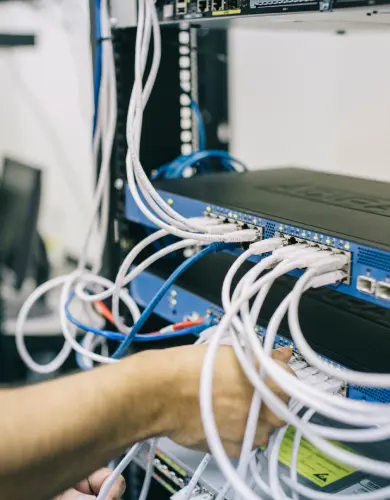
A less common set-up for multi-line phone systems is to manage simultaneous calls on-site using a Private Branch Exchange (PBX) unit.
Here are the common reasons a business might use an on-site PBX-based phone system:
- Control and data sovereignty – Businesses in tightly regulated industries where VoIP security is a priority.
- Local call resilience – Businesses that require internal calls routed through the Local Area Network to continue functioning in the event of a broadband interruption.
- Legacy systems – Some businesses have highly customised PBX systems that were installed before cloud-based alternatives became common. To avoid an expensive overhaul, these businesses continue to use their existing PBX system.
- Reliance on landlines – Businesses that continue to rely on copper-based landlines, particularly in areas with poor broadband coverage, may still use a PBX-based system to manage multiple phone lines.
How do multi-line phone systems work?
In this section, we describe the technology used to deliver simultaneous external calls in multi-line phone systems.
Traditional PSTN multi-line landlines
A traditional PSTN multi-line landline system relies on physical connections to the UK’s national copper landline network.
A single PSTN connection supports one call at a time, so a business requiring up to three simultaneous calls would need three physical lines.
These individual lines feed into a physical PBX unit, which manages how calls are routed internally and connects them to desk phones.
💡 PSTN connections to the landline network will stop being supported in January 2027 as part of the PSTN switch-off.
Traditional ISDN multi-line landlines
ISDN is a digital version of a PSTN connection that enables multiple external calls over a single landline connection:
- ISDN2e – Up to two concurrent calls.
- ISDN30 – Up to 30 concurrent calls.
ISDN connections will also no longer be supported following the upcoming PSTN switch-off.
An ISDN connection feeds into a physical PBX unit, which manages multiple extensions, controls which users receive calls, and allows calls to be transferred.
PBX systems using SIP trunking
On-site PBX systems using SIP trunking continue to rely on PBX hardware to manage users and call routing.
However, to avoid the upcoming switch-off, these systems use a high-capacity broadband connection (typically leased line broadband) to handle external calls. SIP trunking technology allows the broadband connection to carry multiple simultaneous external calls.
Using on-site PBX hardware in this way is often called an on-premises VoIP system.
Business VoIP phone systems
In a business VoIP phone system, the role traditionally performed by PBX hardware is delivered via the business VoIP providers cloud platform.
In larger businesses, desk phones and other mobile devices securely connect to the cloud server, usually using a VPN or a SD-WAN solution.
External calls are then routed over the internet using VoIP technology.
 Back to blog