 Our use of cookies
CityFibre: Who they are and how their network works
CityFibre is one of the UK’s largest independent full fibre network operators, responsible for building and operating wholesale broadband infrastructure across towns and cities nationwide.
Rather than selling broadband directly to homes or businesses, CityFibre provides the underlying fibre network that internet service providers use to deliver ultrafast connectivity.
This guide explains who CityFibre is, why the network was built, how it works, and the role it plays in the UK broadband market.
Who are CityFibre?
CityFibre is an independent wholesale full fibre network operator in the UK. It designs, builds, and operates fibre optic infrastructure that broadband providers use to deliver broadband services to homes and businesses.
The company was established as a challenger to the UK’s long-standing broadband infrastructure provider Openreach. CityFibre’s focus is on expanding the availability of full fibre networks.
CityFibre focuses exclusively on Fibre to the Premises networks, where fibre runs from their local infrastructure directly to the property. This approach avoids the technical limitations of part-fibre networks and is designed to support higher speeds, lower latency, and greater long-term reliability.
Unlike retail broadband providers, CityFibre does not sell services directly to end users. It operates on a wholesale-only basis, providing open access infrastructure that multiple broadband providers can use to deliver services. This wholesale model is intended to increase competition and choice in areas where their network is available.
When was CityFibre founded and why?
CityFibre was founded in 2011 to build a new, independent fibre network in the UK and introduce competition at the infrastructure level of the broadband market.
In its early years, the company focused mainly on the public sector and business connectivity, including:
- Fibre networks for local authorities
- High-capacity connections for enterprises
- Leased line and mobile backhaul services
At this stage, CityFibre’s role was primarily as an alternative wholesale provider for organisations that needed dedicated, high-performance connectivity.
From 2014 onwards, the company began shifting towards large-scale residential and small business broadband. This included the development of Fibre to the Premises networks that could support mass market internet services through retail providers.
One of the first major residential projects was the York full fibre rollout, launched in partnership with Sky and TalkTalk in 2014. This project helped demonstrate that a non-Openreach network could support city-wide broadband services at scale.
Following this, CityFibre expanded its model nationally, securing major investment to fund multi-city rollouts and focusing on building full fibre networks for both homes and SMEs.
Who owns CityFibre?
CityFibre is owned by infrastructure investment funds, not by a consumer broadband brand. Its main shareholders include:
- Antin Infrastructure Partners
- Goldman Sachs Alternatives
- Mubadala Investment Company
- Interogo Holding
These investors specialise in long-term infrastructure projects such as transport, utilities, and telecoms networks.
CityFibre is a privately owned company. It is regulated by Ofcom and operates within the UK telecoms framework, but it is not government-owned, funded, or operated.
How the ownership model works
CityFibre’s owners fund large-scale network construction through a mix of equity and long-term debt. This capital is used to:
- Build fibre networks across multiple regions
- Connect homes and businesses
- Upgrade and expand existing infrastructure
The business then generates profit by providing access to internet service providers in multi-year agreements.
What CityFibre does and how its network is used
CityFibre’s role is to design, build, own, and operate full fibre broadband infrastructure for use by retail internet service providers.
It is responsible for the physical network from planning through to long-term maintenance, while broadband providers handle customer services.
CityFibre’s responsibilities
CityFibre manages the full network lifecycle, including:
- Planning and designing local fibre networks
- Installing ducts, fibre cables, cabinets, and property connections
- Owning and maintaining the infrastructure
- Providing wholesale access to broadband providers
- Managing network capacity and performance
This gives CityFibre direct control over network quality and reliability.
What CityFibre does not do
CityFibre does not operate as a consumer or business broadband provider. This means it does not:
- Bill end users
- Offer consumer contracts
- Provide retail customer support
- Set broadband package pricing
- Handle account management
All of these functions are provided by the retail provider chosen by the customer.
How CityFibre’s full fibre network works
CityFibre builds Fibre to the Premises networks, meaning fibre optic cable runs directly from its network equipment to homes and business premises.
There is no copper in the final connection. The entire route is delivered over fibre, which supports higher speeds, lower latency, and more consistent performance.
This section explains the network’s structure and how it connects to properties.
Core network structure
CityFibre’s network is made up of three main layers:
- Core and metro network: High-capacity fibre routes linking cities, towns, and data centres.
- Local access network: Fibre running through streets and ducts to serve neighbourhoods and business areas.
- Premises connection: A dedicated fibre cable installed in each connected property.
Together, these form a continuous fibre path from the network core to the end user.
Point-to-point and PON networks
CityFibre uses different network designs depending on location and demand.
Some areas use point-to-point leased line connections, where each property has a dedicated fibre back to the exchange.
Others use Passive Optical Network (PON) systems, in which a single fibre is shared among a small group of nearby properties.
Both approaches are designed to deliver high-speed, low-latency services. For most users, the difference is not noticeable in day-to-day use.
What full fibre offers in practice
Because the connection is delivered entirely over fibre, CityFibre networks support:
- Symmetrical upload and download speeds
- Lower latency for real-time applications
- More stable performance at busy times
- Greater long-term upgrade potential
This makes full fibre suitable for cloud services, business VoIP phone systems, and remote working.
How CityFibre connects fibre to business premises
For business properties, installation usually involves:
- Running fibre from the street network into the building
- Installing an internal termination point
- Connecting the fibre to business-grade networking equipment
In multi-tenant buildings, wayleave agreements and shared access arrangements may be required before installation. Find out more in our guide to business broadband installations.
How CityFibre installs fibre to residential properties
For residential properties, installation typically includes:
- Bringing fibre from the nearest access point to the home
- Fitting an Optical Network Terminal inside the property
- Connecting the ONT to the customer’s router
Most home installations are completed in a single visit.
How CityFibre differs from Openreach
CityFibre and Openreach both operate broadband access networks in the UK, but they are separate companies operating separate infrastructure.
CityFibre does not use the Openreach network to deliver its services. Instead, it builds and operates its own full fibre network in the areas it covers.
This means that in many towns and cities, homes and businesses may be served by more than one independent fibre network.
Key differences between CityFibre and Openreach
The table below summarises the key differences between the CityFibre and Openreach networks.
| Feature | CityFibre | Openreach |
|---|---|---|
| Network ownership | Owns and operates its own fibre network | Owns and operates the BT access network |
| Primary technology | Full fibre only | Mix of FTTP and legacy SoGEA services |
| Use of copper | No copper in the access network | Still supports copper in some areas |
| Wholesale model | Wholesale only | Wholesale and broadband services provided by BT business broadband |
| Retail services | Does not sell directly | Does not sell directly |
| Network build approach | New build fibre infrastructure | A combination of upgrades and a new build |
| Geographic coverage | Selected cities and regions | Nationwide coverage |
| ISP access | Multiple partner providers | Multiple partner providers |
In areas where both CityFibre and Openreach have built networks, each company owns and operates its own physical infrastructure.
CityFibre is also part of a wider group of independent network operators, sometimes referred to as alternative networks, which includes providers such as Community Fibre and Hyperoptic. These companies build and run their own full fibre networks in selected regions, particularly in urban areas.
Rather than relying on a single national access network, the UK broadband market supports multiple companies investing in parallel fibre infrastructure.
For customers, this can mean more choice between providers and stronger competition.
Does CityFibre use Openreach infrastructure at all?
In most cases, no. CityFibre builds and operates its own ducts, fibre routes, cabinets, and network equipment.
Its network is physically separate from Openreach’s, and when a property is connected, the installation, equipment, and ongoing service delivery are handled entirely by CityFibre and its retail partners.
However, in limited circumstances, CityFibre may use existing infrastructure through regulated access agreements, such as duct and pole sharing schemes, local authority-owned duct routes, or shared access in constrained locations.
Where is CityFibre available in the UK?
CityFibre’s full fibre network is available across many parts of England and Scotland, with coverage focused on major towns, cities, and surrounding urban areas.
The map below shows current CityFibre coverage. Areas highlighted in green indicate locations where CityFibre’s network is live or in active deployment.
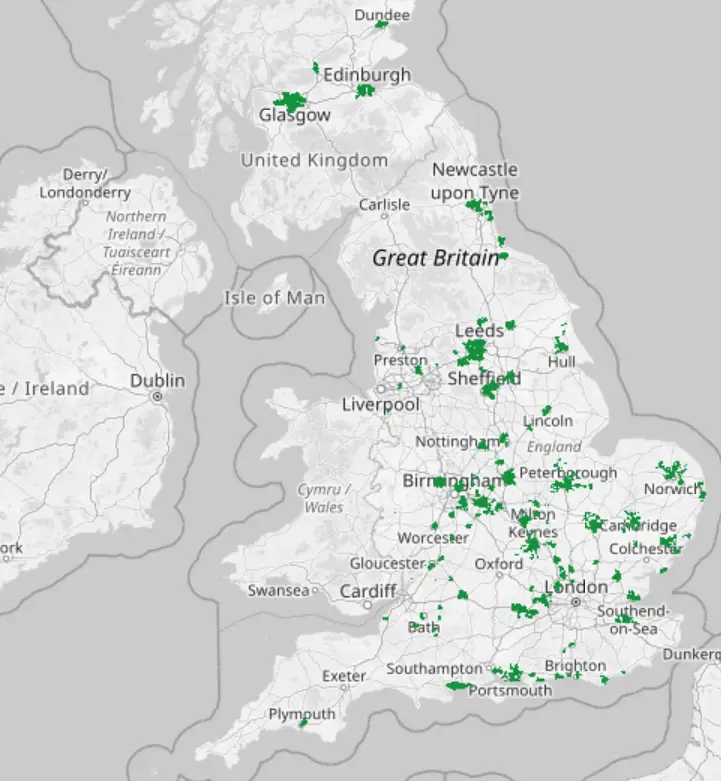
Source: Thinkbroadband – January 2026
Rather than building a single national network, CityFibre rolls out infrastructure on a location-by-location basis. This means availability can vary significantly between neighbouring towns and even between streets in the same area.
Coverage continues to expand as new build programmes are completed and existing networks are extended.
How to check if CityFibre is available for your business
The easiest way to check whether CityFibre is available at your business premises is to use the official CityFibre availability checker.
By entering your postcode and selecting your address, you can see whether full fibre broadband or Ethernet services are currently available at your location.
To check availability:
- Enter your business postcode
- Select your address from the results
- View the network status shown on screen
The checker typically displays one of the following outcomes.
“Great News! Full Fibre Broadband is available”
If you see this message, CityFibre’s network is live at your business address. This means you can order a service through one of CityFibre’s broadband providers.
“Good news! Full Fibre Broadband is coming soon”
This type of message indicates that CityFibre is currently building its network in your area and plans to make services available in the near future.
Your address is part of an active rollout, but installation work has not yet been completed.
“CityFibre’s broadband and Ethernet services aren’t currently planned in your area”
If this message appears, CityFibre does not currently have confirmed build plans for your location.
Availability information is updated as build programmes progress, so it is worth checking again if work is taking place nearby.
Which broadband providers use CityFibre?
CityFibre operates an open access wholesale network. This means it builds and maintains the fibre infrastructure, while multiple broadband providers use that network to sell services directly to homes and businesses.
Each provider sets its own pricing, packages, support levels, and service policies, even though they use the same underlying network.
Not all providers are available in every location. The options you see will depend on which providers are active in your area.
| Provider | Residential | Business | Notes |
|---|---|---|---|
| Vodafone | Yes | Yes | One of the largest CityFibre partners, available in many areas |
| TalkTalk | Yes | Yes | Offers both consumer and business services |
| Sky | Yes | Limited | Rolling out full fibre over CityFibre in selected areas |
| Zen Internet | Yes | Yes | Known for business-grade support and reliability |
| Giganet | Yes | Limited | Focuses mainly on full fibre services |
| No One Internet | Yes | Yes | Strong presence in CityFibre build areas |
| Andrews & Arnold | Yes | Yes | Business and technical-focused provider |
| toob | Yes | No | Available in selected regions only |
| Link Broadband | Yes | Yes | Active in specific CityFibre locations |
This list is not exhaustive. CityFibre continues to add new partners as the network expands.
Why speeds and prices vary between providers
Even though these providers use the same CityFibre network, their broadband packages can differ significantly.
This is because each provider controls:
- Package pricing and contract length
- Speed tiers and upload limits
- Traffic management policies
- Optional features such as static IPs or enhanced SLAs
For example, one provider may focus on low-cost consumer packages, while another prioritises business-grade support and guaranteed response times.
CityFibre supplies the physical network, but the retail provider you choose determines the service experience.
What services do CityFibre support for businesses?
CityFibre’s network underpins a range of connectivity services designed specifically for business use.
Through its wholesale partners, organisations can access high-performance, scalable connections suitable for day-to-day operations, cloud systems, and critical communications.
The main business services supported on the CityFibre network are outlined below.
Business full fibre broadband
CityFibre enables full fibre business broadband for companies that need fast, reliable internet without the cost of dedicated circuits.
These connections are delivered using Fibre to the Premises technology and are suitable for:
- Small and medium-sized businesses
- Cloud-based systems and SaaS platforms
- VoIP and video conferencing
- Remote and hybrid working
This option is often used as a cost-effective alternative to legacy part-fibre services.
Business Ethernet and private circuits
For organisations that require guaranteed performance, CityFibre supports Business Ethernet services through its partner providers.
These are private, uncontended connections that link business sites directly to network hubs or data centres.
Business Ethernet is commonly used for:
- Multi-site wide area networks
- Secure data transfers
- Cloud connectivity
- High availability internet access
Leased lines and dedicated internet access
CityFibre supports business leased line services for organisations with high bandwidth and uptime requirements.
These provide dedicated fibre connections with symmetrical speeds and service level agreements. Leased lines are typically used by:
- Larger offices and corporate sites
- Financial and professional services firms
- Healthcare and education providers
- Data-intensive operations
Business voice and unified communications
Many CityFibre partners deliver business voice services over the fibre network, including:
- Business phone lines
- Hosted VoIP platforms
- VoIP integrations
- Cloud PBX systems
- Unified communications tools
The low latency and reliability of full fibre support high call quality and stable conferencing.
SD WAN and managed network services
Some providers use CityFibre’s infrastructure to deliver managed networking solutions, including SD WAN solutions and SASE.
These services allow businesses to connect multiple sites securely while prioritising critical applications.
They are commonly used by organisations with:
- Distributed offices
- Retail and hospitality estates
- Hybrid working models
Resilient and backup connectivity
CityFibre-based services are often used as part of resilient connectivity setups. This can include:
- Secondary fibre connections
- Dual-routed Ethernet services
- Diverse path installations
- Integrated 4G and 5G business broadband backup
These solutions help minimise downtime and maintain business continuity.
How service availability varies for businesses
Not every business location will support all service types.
For example, some premises may be suitable for standard business broadband but not for Ethernet or leased lines, depending on local network design and building access.
Availability is influenced by:
- Network capacity in the area
- Exchange and aggregation points
- Wayleave permissions
- Provider coverage
As CityFibre continues to expand its network, the range of business services available in each location is expected to increase.
Is CityFibre reliable?
CityFibre operates a full fibre network, which is generally more reliable than part fibre and copper-based broadband.
Because data is carried over fibre optic cables rather than electrical signals, the network is less affected by interference, distance, and weather-related issues. This helps deliver more consistent performance and fewer faults.
CityFibre is responsible for maintaining and repairing the physical network. When faults occur, they are reported through retail providers and resolved by CityFibre engineers.
At a network level, CityFibre also builds in business broadband redundancy, with multiple fibre routes and backup systems designed to reduce the impact of major outages.
While full fibre is highly reliable, no single connection is immune to disruption. Users who need higher resilience may benefit from broadband failover solutions.
Is CityFibre down?
If you’re experiencing problems, the first step is to contact your broadband provider, as they can check whether there is a known fault on the CityFibre network in your area.
For a quick indication of wider issues, you can also check independent outage reporting sites such as DownDetector, which show whether other users are reporting problems at the same time.
If no wider outage is reported, the issue is more likely to be specific to your connection, business broadband router, or provider.
CityFibre reviews
CityFibre has an excellent Trustpilot score of around 4.7, reflecting feedback from both residential and business users who access services through its partner providers.
Because CityFibre operates as a wholesale network, reviews often relate to installation quality, network reliability, and overall service stability rather than billing or contracts.
Below is a summary of common themes from customer feedback.
Pros
- Many users praise the reliability and speed of CityFibre full fibre connections, particularly compared to older part-fibre services.
- Installation appointments and engineer visits are frequently described as professional and efficient.
- Customers often report improved performance for home working, video calls, and cloud-based services after switching.
- Network stability and low latency are regularly highlighted in positive reviews.
Cons
- Some users report delays during the initial rollout or installation phase in newly built areas.
- Because CityFibre does not provide retail services, some customers are unsure whether to contact their provider or CityFibre when faults occur.
CityFibre contact details
CityFibre does not provide direct customer support for broadband services. If you are already connected to the CityFibre network or have an installation planned, you should contact your broadband provider for all service-related enquiries.
This includes support for:
- Connection problems
- Speed issues
- Billing queries
- Account management
- Installation updates
Your provider will then liaise with CityFibre if a network-level issue needs to be investigated.
For health and safety concerns, CityFibre can be contacted on 0800 083 6160, 24 hours a day.
 Back to blog