 Our use of cookies
Business broadband contention: Contended vs uncontended lines
Businesses have two choices when it comes to internet access: Rely on a shared “last mile” network where capacity is limited and bandwidth is contended, or pay a premium for a fully dedicated leased line that guarantees uncontended performance.
This guide explores both options, explains how contention works, and gives strategies for mitigating its effects when dedicated lines are not an option.
Contents
- What is broadband contention?
- What is a contention ratio?
- Contended vs uncontended business broadband
- Why does broadband contention happen?
- How contention affects businesses
- How to reduce broadband contention
What is broadband contention?
Broadband contention is the real-time competition for bandwidth that occurs in the “last mile” of a broadband network, where local street cabinets and fibre hubs distribute connectivity to homes and businesses.
Each cabinet draws a limited backhaul from the UK’s core network, typically 1–10 Gbps, and must share this across dozens or even hundreds of subscribers, as illustrated below:
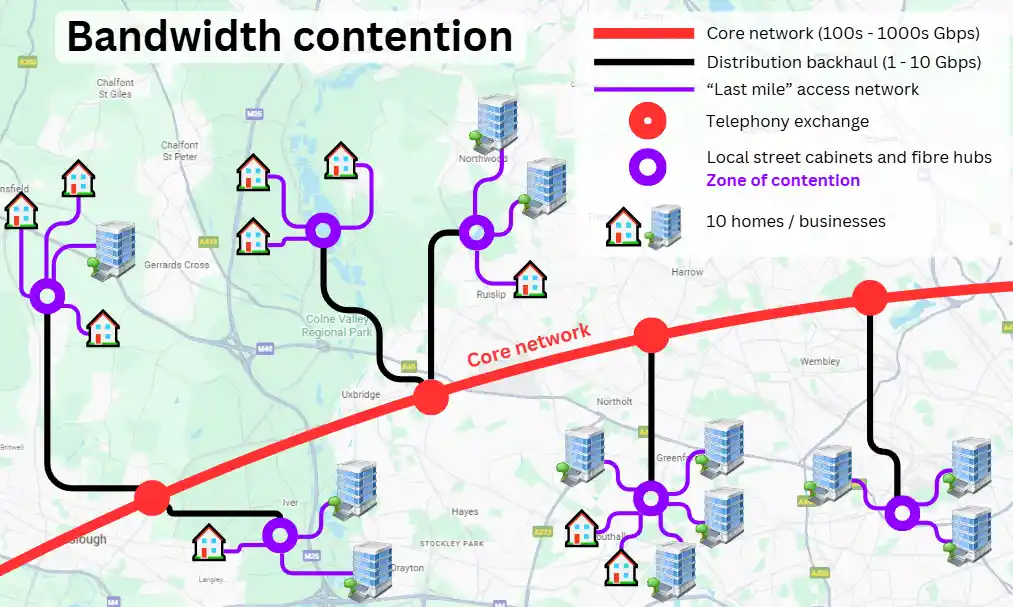
When simultaneous demand exceeds that capacity, contention sets in, producing bottlenecks, noticeable latency, and throttled throughput.
This shared access model is cost-effective for infrastructure providers like Openreach and KCOM, and is engineered to ensure that both business and residential customers receive sufficient bandwidth most of the time. Noticeable contention arises only during peak internet hours.
This is why the real-world performance of shared broadband often falls short of the advertised “up to” speeds, and usually only approaches them during low-traffic times, such as the middle of the night.
The opposite is true in uncontended, fully uncontended, dedicated business leased lines that run directly from telephony exchanges at the core network. These connections are guaranteed a fixed bandwidth regardless of congestion by skipping the last mile segment.
Factors influencing broadband contention
The level of broadband contention in the network depends on:
- Simultaneous active users on that shared segment
- Capacity of the cabinet/node/backhaul supporting that segment
- Provider’s traffic management policies and ability to handle peak demand
- Type of broadband (contended or uncontended)
- Service Level Agreement (SLA) in place
- Property type, with residential properties vulnerable to bandwidth throttling.
What is a contention ratio?
The contention ratio expresses potential broadband contention by describing the maximum number of customers that can share the same pool of bandwidth on a last-mile segment.
Contention Ratio (R) = Number of connections provisioned on a last mile broadband hub
For example, a 20:1 ratio means that up to 20 customers can draw from the same capacity simultaneously. If only a few are active, each can approach their advertised “up to” speeds; if many are active simultaneously, each receives a smaller share.
However, contention overly simplifies actual bandwidth distribution as it ignores other crucial factors, such as the SLA performance guarantees of each customer or the provider’s traffic management for that local hub.
Typical contention ratios by connection technology
Contention ratios vary by broadband technology and the architecture of each local network.
For example, a busy business district may be provisioned differently from a quiet residential street. Network planners can also split lines in different ways depending on expected demand, which changes the effective contention.
The table below summarises typical contention levels for the main broadband technologies in the UK. It also displays the “up to” speeds customers can expect during uncongested periods to estimate the actual bandwidth typically available for each one.
| Connection Type | Contention Ratio | Typical "up to" speeds per customer | Description |
|---|---|---|---|
| Business leased line broadband | 1:1 (uncontended) | 1-10 Gbps | Dedicated circuits for businesses. No contention and ample bandwidth ensures consistent, symmetrical speeds and performance, even during peak times. |
| EFM (Ethernet in the First Mile) | 1:1 (uncontended) | 35 Mbps | Dedicated bonded copper pair circuits for businesses; but speed-limited and signal degrades with distance from exchange. |
| Full fibre business broadband | 32:1 to 64:1 | 100 Mbps-1Gbps | Same access for businesses and homes. Contention occurs at PON splitters where backhaul fibre link from core is split into 32 or 64 individual lines using PON (2.5/1.24 Gbps) or XPS-PON (10 Gbps symmetrical). Limited contention and ample backhaul bandwidth reduces the impact of peak-time congestion, though slowdowns can occur. |
| Cable business broadband | 50:1 to 200:1 | 100 Mbps-1Gbps | Tens to low-hundreds of subscribers share a local node/service group; contention is proportional to active users. DOCSIS mitigates via scheduling and node-splits. |
| SoGEA business broadband | 30:1 to 50:1 | 20-80Mbps | Dozens of premises share local cabinet capacity. Ofcom’s USO treats 1:50 contention as max benchmark for SoGEA. |
| ADSL | 50:1 (residential), 20:1(business) | 1-20 Mbps | Legacy connection; some connections remaining in rural areas. Contention uses Legacy BT Wholesale benchmarks. |
Note: Customers using wireless internet services such as business satellite broadband and business mobile broadband also share finite capacity, but don’t express this competition as “contention” as the bandwidth distribution mechanics work differently.
Contended vs uncontended business broadband
While contention in the last mile segment is a nuanced matter, some business-only connections offer fully dedicated bandwidth to the properties by bypassing the access layer altogether and plugging directly into the core network.
This leaves two types of connections:
- Contended broadband: Limited bandwidth is shared with other subscribers, so it suffers from contention.
- Uncontended broadband: Fixed bandwidth that is not shared with others, so it does not experience contention.
Here are the key characteristics of each:
| Category | Uncontended Broadband | Contended Broadband |
|---|---|---|
| Definition | Dedicated bandwidth exclusively for one business, unaffected by other users. | Bandwidth is shared among many users, so performance varies with demand. |
| Connection Types | Leased line broadband and Ethernet in the First Mile (EFM) | Standard broadband connections: ADSL, SoGEA, cable, full fibre. |
| Performance | Consistent speeds, low latency, and stable performance even at peak times. | Speeds drop and latency/jitter rise during busy periods, impacting real-time apps like VoIP and video calls. |
| Infrastructure | Direct links into exchanges or core network, with no (or very limited) shared capacity. | Shared aggregation points: DSLAMs for copper, splitters for fibre, and DOCSIS groups for cable. |
| Cost | Higher, reflecting guaranteed and uncontended service. | Lower, due to shared resources. |
Why does broadband contention happen?
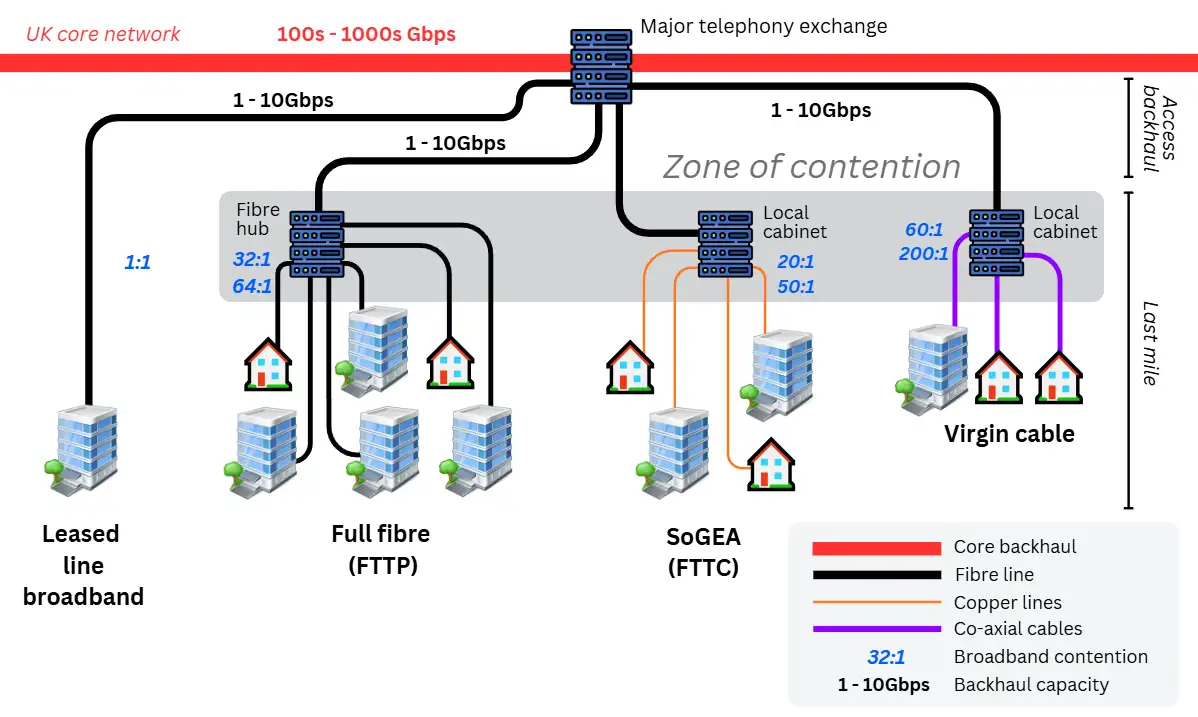
Bandwidth contention occurs because multiple customers must share a limited amount of backhaul bandwidth. Each local aggregation point serves tens to hundreds of business and residential customers and only receives between 1 and 10 Gbps of bandwidth to distribute.
At local street cabinets, DSLAMs split bandwidth across up to 50 copper wire connections, and Virgin DOCSIS nodes can split this bandwidth across hundreds of coaxial cable connections (once used for cable television services).
At fibre distribution hubs, the fibre link extended from the nearest telephony exchange is split using PON or XGS-PON splitters, which deliver distinct levels of performance for up to 64 full fibre connections (2.5/1.24 Gbps for PON, 10/10 Gbps for XGS/PON).
The reality is that there are not enough resources to let every customer run at the maximum “up to” speed of their broadband plan at the same time. Maximum speeds are only truly possible during low-traffic periods, usually in the middle of the night.
The exception is leased lines, which don’t suffer from any contention because providers extend a dedicated connection directly from telephony exchanges, effectively by-passing all aggregation points.
What are peak broadband contention times?
Peak contention times in shared networks coincide with “internet rush hours”, where customers are the most active. However, the peaks depend on the type of properties using the local hub.
In residential and mixed areas: The busiest times are 7pm-11pm, when households are streaming video (Netflix, YouTube, iPlayer), gaming online, or on video calls. Traffic usually peaks around 8-9pm, which is often referred to as the residential “internet rush hour”.
In business hubs, multi-tenant buildings, and campuses: Peak demand occurs during the working day, typically 8am–5pm, with the heaviest load between 11am–2pm as employees overlap with heavy use of their business VoIP phone systems and SaaS tools.
What do broadband providers do to handle contention?
During these busy windows, business broadband providers apply traffic management policies to control congestion and maintain service quality. These can include:
- Throttling speeds for heavy users or specific applications (mainly on residential lines).
- Prioritising real-time traffic like VoIP and video calls over large downloads or backups.
- Balancing load across multiple backhaul links to prevent bottlenecks.
- Using smart queueing to reduce latency under congestion.
- Caching popular content (e.g. Netflix, YouTube, Windows updates) closer to users.
- Enforcing fair usage policies or time-of-day shaping to spread bandwidth more evenly.
💡 Read our guide to business DNS setups to see ways to improve performance through caching.
How contention affects businesses
The reduction in bandwidth and throttling of non-critical processes that occur during high contention affect all businesses in shared networks, even those with internal strategies in place.
The impacts touch on the business’s communications, operations, scalability, costs, and security:
Inconsistent real-time communication (VoIP, video calls)
The most immediate effects are usually on live communications. While providers prioritise real-time traffic to preserve call quality, this is not always sufficient during heavy congestion.
Too little bandwidth inevitably leads to higher latency and packet loss. For example, if 100 Mbps of outgoing voice and video traffic competes for only 80 Mbps, some data simply cannot be transmitted in real time.
The result is degraded VoIP call quality, characterised by delayed audio, echoes, or choppy sound, accompanied by reduced video resolution or frozen feeds.
Productivity and operational delays
Operational workflows suffer in less obvious but equally damaging ways. Traffic from CAD software, 3D modelling, video editing, or other graphics-heavy SaaS platforms does not benefit from the provider’s prioritisation. It is treated like any other on the last-mile network.
Insufficient bandwidth renders these workflows sluggish and unreliable, slowing project delivery and collaboration. This is why industries reliant on data-intensive applications often invest in uncontended broadband packages.
Hidden costs of contended broadband
Contended broadband may seem cost-effective, but for organisations with moderate to heavy bandwidth needs, the savings are often short-lived.
Performance losses on key applications cut employee efficiency, disrupt customer platforms during peak times, and erode revenue. These costs can quickly outweigh the premium of a leased line.
Additionally, upgrading mid-contract can incur steep termination fees, which means businesses that underestimate contention often pay more in the long run than if they had invested in a dedicated line from the start.
Security and reliability concerns
A congested broadband connection also increases vulnerability. Overwhelmed networks are easier targets for DDoS attacks, which in turn reduces the effectiveness of security monitoring tools, such as cloud-based firewalls.
While less common than phishing, these cybersecurity threats exploit weak connections; no business is too small to be targeted, as demonstrated by the 2025 UK supermarket supply chain cyberattacks.
How to reduce broadband contention
The severity of bandwidth contention depends on various factors outside the control of businesses.
That said, businesses still have several tools to minimise contention and maintain reliable connectivity, even when a fully uncontended service isn’t available:
1. Choose uncontended internet services
The most direct way to eliminate contention is to use a connection with a 1:1 contention ratio, where all bandwidth is dedicated to the premises.
The most common option for SMEs is a business leased line (also known as Dedicated Internet Access or DIA). These offer symmetrical speeds, fixed bandwidth, and strict SLAs by connecting directly to the core network.
For multi-site businesses interconnecting sites, data centres and cloud apps across a wide area network, other uncontended options include:
- Point-to-point leased lines: Dedicated links between sites, data centres, or cloud PoPs.
- Ethernet in the First Mile (EFM): Bonded copper pairs, often used in underserved areas.
- MPLS: Not inherently uncontended, but can operate as such through traffic tagging.
- Wireless leased lines: High-bandwidth, uncontended wireless connections (limited availability).
- Dark fibre: Leased fibre segments, typically used for custom dedicated networks.
2. Choose high-performance contended services
Where a leased line business broadband installation is unavailable or uneconomical, such as in rural locations or businesses with low bandwidth needs, well-chosen contended services can still perform effectively.
A business broadband comparison service outputs a list of all available services at the premises.
Ranked by quality:
- Full fibre (FTTP): Entirely fibre-based, often with symmetrical speeds and higher “up to” guarantees.
- Virgin cable: Part-fibre, part-coaxial; supports speeds above 1 Gbps and generally outperforms other hybrid options.
- SoGEA (FTTC without landline): Part-fibre, part-copper; most prone to contention and least desirable.
3. Use redundancy for load balancing and failover
Business broadband redundancy combines multiple connections (often contended ones) into a single logical service using multi-WAN business broadband routers.
This helps reduce the effects of contention by enabling:
- Load balancing: Distributing traffic across connections for better performance.
- Business broadband failover: Reserving bandwidth on a backup line for uninterrupted uptime.
For larger organisations, business SD-WAN solutions extend redundancy across multiple sites. This approach is most effective when lines use different last-mile networks (e.g., pairing fibre with 5G broadband for businesses or satellite business internet) to avoid simultaneous congestion.
4. Optimise the local area network for contention
Finally, businesses can optimise other parts of their local area networks setup to ensure they can make better use of limited bandwidth:
- Enable Quality of Service (QoS) at the router: Prioritise traffic for critical applications such as VoIP, CAD, or online payments. While provider QoS ultimately governs the last mile, local QoS still improves internal efficiency.
- Schedule large uploads outside peak times: Run backups or bulk file transfers overnight to free bandwidth during working hours.
- Monitor bandwidth usage: Use network monitoring tools to detect bottlenecks and adjust QoS policies accordingly.
Broadband contention FAQs
Our business broadband experts answer frequently asked questions (FAQs) regarding broadband contention:
What is a good contention ratio?
Lower contention is always better, but it’s only one factor for performance. Backhaul capacity, traffic management, and the access technology matter just as much.
For example, a 64:1 split on full fibre (FTTP) will outperform a 20:1 FTTC (part-copper) line because fibre offers far higher baseline capacity.
Does contention affect upload speeds?
Yes. Contention impacts both download and upload, but businesses often feel it most on the uplink. Real-time and cloud-heavy traffic such as VoIP, video calls, backups, and payment processing, are especially sensitive to limited upstream bandwidth.
Is uncontended broadband worth the cost for SMEs?
It depends on the business profile:
- Micro-businesses with minimal online needs: A standard contended connection, ideally with a 4G/5G backup, is usually sufficient.
- SMEs with light cloud/communication needs: One or more full fibre connections with QoS configuration can balance cost and reliability.
- SMEs with medium to heavy reliance on cloud, UCaaS, or online transactions: An uncontended leased line becomes essential, as even short disruptions can directly affect productivity and revenue.
 Back to blog