 Our use of cookies
What is cable broadband?
Cable broadband is a hybrid fibre-coax connection that delivers high-speed internet using:
- Fibre optic cables to deliver internet data across the wider network and into local hubs
- Coaxial cable for the final last mile segment from the local hub to a property.
This hybrid network delivers ultrafast speeds without requiring fibre installation in every building. Virgin Media operates the only large-scale cable broadband network in the UK. Its infrastructure reaches more than 16 million premises and supports download speeds of up to around 1,100 Mbps. In areas without full fibre coverage, cable broadband remains a widely available high-speed fixed-line option.
This guide explains what cable broadband is, how a cable broadband connection works, where it is available in the UK and how businesses commonly use it.
Cable broadband connection process
A cable broadband connection uses Hybrid Fibre Coaxial (HFC) technology. Fibre optic cables carry large volumes of data across the national network, while coaxial cable is used for the final connection into homes and businesses.
Below is a step-by-step explanation of how the requested data travels across a cable broadband connection:
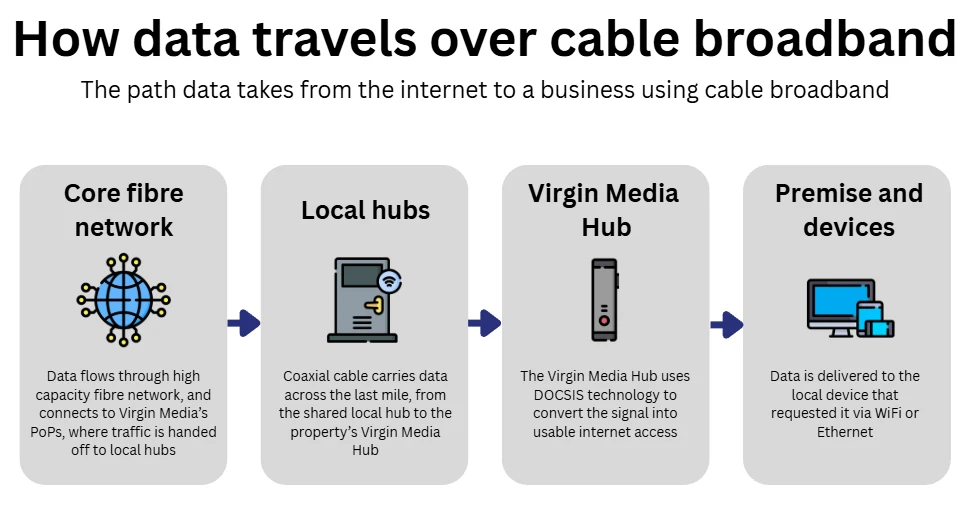
Core fibre network
Data requested by cable broadband customers travels across the global and internet core networks before entering Virgin Media O2’s national broadband infrastructure at Virgin Media’s peering and transit points of presence (PoPs).
Once traffic enters Virgin Media’s broadband infrastructure, it is carried across the company’s high-capacity fibre core and distribution network. This fibre network delivers data to local network hubs, where it is handed off to the coaxial access network that connects homes and businesses.
Coaxial cable for the final mile
From the local hub, the connection switches from fibre to coaxial cable for the final short distance into each property. Coaxial cable is used to carry data because it can carry high-frequency signals reliably over short to medium runs. Coax is used because:
- It avoids the disruption of installing new fibre to every premise
- It supports high download bandwidth using DOCSIS technology
- It is cost-effective to maintain and incrementally upgrade
- It can serve multiple nearby properties from a single node
The coaxial segment is shared among users connected to the same local area, meaning available bandwidth is contended locally during peak usage periods; however, capacity is actively managed through network segmentation and upgrades.
Cable modem and router
Inside the property, the coaxial cable connects to a Virgin Media Hub that serves as both a cable modem and a business broadband router. The modem communicates with the wider cable access network, while the router distributes the internet connection within the building.
Virgin Media cable broadband uses DOCSIS technology to transmit data over coaxial cable. Modern services operate on DOCSIS 3.1, which enables:
- Gigabit download speeds
- Improved spectral efficiency and network capacity
- Better performance when many devices are online
The Hub converts the incoming signal into usable internet access via WiFi (WLAN) and wired Ethernet.
Cable broadband installation
Virgin Media most frequently installs service at premises that already have a Virgin Media coaxial cable connection (or have had one in the past). These organisations are considered “serviceable” because they are already connected to the local cable network.
This also means installation is usually simpler than a new leased line or full fibre connection, because much of the network infrastructure is already in place.
The installation process typically involves the following steps:
Network availability check
Before installation, Virgin Media confirms that the property is connected to the local cable network footprint and that service capacity is available at the nearest cabinet or fibre node.
External connection
If the property is not already connected, a coaxial cable is run from the local node to an external wall.
Internal installation
A small hole is drilled to bring the coaxial cable inside the building. The cable is connected to a wall outlet, which then connects to the Virgin Media Hub.
Router setup and activation
The Hub is powered on and activated on the network. Once live, it converts the incoming cable signal into internet access for devices via the local area network.
In most cases, properties have an existing cable connection, enabling quick installation with minimal disruption. Where no existing drop cable or entry point exists, additional external work may be required before the service can go live.
How fast is cable broadband?
Virgin Media exclusively offers broadband plans on the cable network. The following table shows the home and business broadband speed tiers and plans available from Virgin on the cable network:
| Cable Plan Name | Customer Type | Average Speeds |
|---|---|---|
| M125 Fibre | Household | 132Mbps download, 20Mbps upload |
| M250 Fibre | Household | 264Mbps download, 25Mbps upload |
| M350 Fibre | Household | 362Mbps download, 35Mbps upload |
| M500 Fibre | Household | 516Mbps download, 52Mbps upload |
| Gig1 | Household | 1,130Mbps download, 104Mbps upload |
| Voom 200 | Business | 200Mbps download, 20Mbps upload |
| Voom 400 | Business | 400Mbps download, 40Mbps upload |
| Voom 600 | Business | 600Mbps download, 60Mbps upload |
| Voom Gig1 | Business | 1,000Mbps download, 100Mbps upload |
Virgin Media frequently runs time-limited offers. For the latest home and business broadband prices, visit the Virgin Media website.
Cable broadband coverage and availability
Cable broadband in the UK is delivered exclusively over Virgin Media’s network, which is the second-largest fixed broadband infrastructure after Openreach. Its reach is concentrated in towns and cities, where the original cable network was built to support television and broadband services.
Where is cable broadband available?
Virgin Media cable broadband is mainly available in urban and suburban areas across England, Scotland and Wales. The network reaches around 56 per cent of UK premises, although availability can vary significantly between neighbouring streets.
Cable broadband is less common in rural locations, where the original cable network was never deployed, and mobile broadband or wireless leased lines services are more likely to be available.
You can learn more about broadband availability by location on our business broadband availability page.
Cable broadband location checker
The easiest way to check cable broadband availability is to use Virgin Media’s postcode checker. Entering a postcode confirms whether a property is connected to the local cable network and which speed tiers are available.
If multiple broadband technologies are available at your address, it can be useful to review all options side by side. Our business broadband comparison service provides you with the options available to your business so that you can make an informed decision.
Cable broadband expansion
Virgin Media is no longer expanding its Hybrid Fibre Coaxial network. Instead, long-term investment has shifted towards full fibre, which offers higher upload speeds, lower latency and greater scalability.
Future expansion is being delivered through the Nexfibre network partnership, which is rolling out full fibre infrastructure rather than cable broadband. The Nexfibre rollout aims to make full fibre available to up to 5 million premises by the end of 2026.
As a result, cable broadband coverage is expected to remain broadly unchanged, while full fibre availability continues to expand.
What do businesses use cable broadband for?
Businesses use cable broadband where they need fast download speeds, wide availability and a connection type that sits outside the Openreach network. Below are the most common business use cases for cable broadband.
Primary broadband for small businesses
Many small businesses rely on cable broadband as their primary internet connection. It is well suited to day-to-day activity such as cloud apps, email, web access and business VoIP phone systems, without the higher costs associated with leased lines or full fibre in some areas.
Supporting multiple users in growing teams
Cable broadband plans with higher-speed tiers can support multiple staff working online simultaneously. This makes it suitable for medium-sized offices where multiple users access cloud platforms, video calls, and shared systems throughout the day.
However, cable broadband may struggle to meet the demands of teams with high upload traffic (e.g., cloud computing, data backups, large file transfers), as DOCSIS technology provides asymmetric speeds, with lower upload capacity compared to download speeds.
Backup and resilience
Because cable broadband does not run over the Openreach network, it is often used as a secondary connection for business broadband redundancy. If a primary service goes down, cable broadband can keep essential systems online.
Load balancing and bandwidth expansion
Some businesses use cable broadband alongside other connections in a network load-balancing setup. This spreads traffic across multiple lines, increases total available bandwidth and helps maintain performance during busy periods.
Cable broadband FAQs
Our business broadband experts answer frequently asked questions regarding Virgin Media’s cable broadband:
How does cable broadband compare with SoGEA?
SoGEA business broadband is a part-fibre service delivered exclusively over the Openreach network. It uses fibre to the street cabinet, with the final connection relying on infrastructure originally associated with a business phone line.
In contrast, cable broadband uses a coaxial cable to provide the final connection to the property. This allows much higher download speeds, with SoGEA typically capped at around 80Mbps compared with cable broadband speeds of up to 1.1Gbps.
Is cable broadband the same as full fibre?
No. Cable broadband and full fibre business broadband are different technologies. Full fibre uses fibre optic cabling all the way from the core network directly into the property, which results in lower latency, higher upload speeds and better long-term scalability.
Cable broadband relies on fibre for most of the journey but uses coaxial cable for the final connection. While it still supports ultrafast downloads, full fibre generally delivers stronger overall performance where available.
How does cable broadband differ from a leased line?
A leased line business broadband connection is delivered over a dedicated fibre optic circuit installed exclusively for one business. Because the connection is not shared with other users, it is classed as uncontended broadband and delivers consistent speeds throughout the day.
Cable broadband is a shared service, with local bandwidth distributed between multiple users connected to the same cabinet. This enables faster rollout and lower costs, but performance may vary slightly during peak times.
Virgin Media are also a leased line broadband provider alongside their cable broadband service.
 Back to blog