 Our use of cookies
Gigabit Broadband Voucher Scheme for businesses
The Gigabit Broadband Voucher Scheme (GBVS) provides government subsidies of up to £4,500 per property to incentivise broadband suppliers to expand their fibre networks to underserved areas.
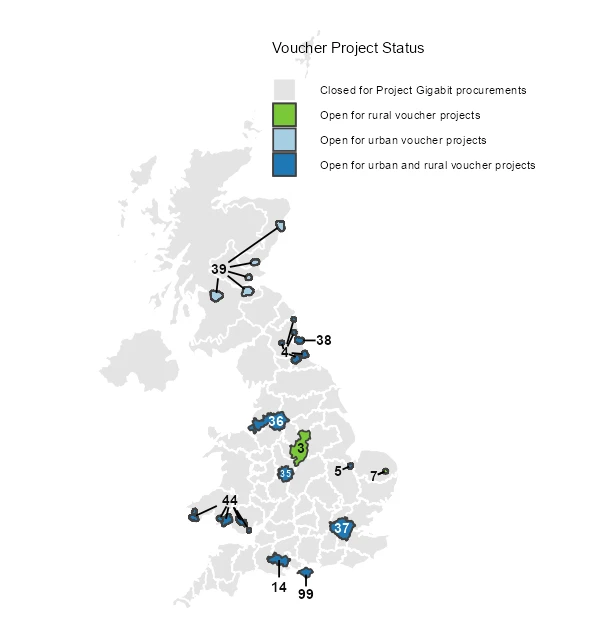
It’s only available in limited areas; check the map here.
This article explains the GBVS in detail, including eligibility, availability, how to apply, and key terms in the small print.
Content highlights:
- What is the Gigabit Broadband Voucher Scheme (GBVS)?
- How to apply for the Gigabit Broadband Voucher
- Who can apply for a Gigabit Broadband Voucher?
- Where is the Gigabit Broadband Voucher Scheme (GBVS) available?
- How much funding can my business get from the Gigabit Broadband Voucher Scheme?
What is the Gigabit Broadband Voucher Scheme (GBVS)?
The Gigabit Broadband Voucher Scheme (GBVS) is a government programme run by Building Digital UK (BDUK) to help bring full fibre broadband to homes, small businesses, and community buildings in areas with poor connectivity.
It offers funding worth up to £4,500 for each eligible property that gets connected, and in some areas, local councils provide additional top-up funding, which can increase this to more than £7,500.
The funding doesn’t go to the homes or businesses themselves. Instead, it goes to an approved broadband supplier to help cover the cost of building the new fibre network.
To access the scheme, several nearby homes and businesses need to club together and approach a registered supplier. The supplier then pools their vouchers, applies to BDUK for funding on their behalf, and builds the connection.
Once the new network is live and confirmed to deliver gigabit speeds, BDUK pays the voucher money directly to the supplier. This reduces or removes the upfront installation costs for the homes or businesses taking part.
The scheme is aimed at “hard-to-reach” or underserved areas where commercial rollout isn’t expected. Small and medium-sized businesses and not-for-profit organisations can qualify if they meet BDUK’s size, turnover, and subsidy rules.
How does the gigabit voucher work?
Rather than giving money directly to businesses or households, the scheme funds accredited broadband infrastructure suppliers who manage the entire process of customers.
Here’s how it works behind the scenes:
A supplier-led model
The GBVS is structured to make fibre builds viable in areas where they would otherwise be too costly. Instead of issuing grants directly to applicants, funding flows through accredited suppliers who design, apply for, and deliver projects.
This approach ensures accountability, avoids duplication with other rollouts, and keeps the process straightforward for businesses and households.
Voucher allocation and funding release
Each eligible premise is assigned a voucher value of up to £4,500. Suppliers pool these vouchers to offset the high capital cost of extending fibre, especially in areas without existing infrastructure like ducts or poles.
Once the build is completed and independently verified as gigabit-capable, BDUK releases the funds straight to the suppliers. Businesses then contract an internet service over their new Gigabit-capable connection, usually by comparing business broadband deals to leverage competition and get the lowest business broadband prices.
Local authority top-ups and group projects
Local councils often add supplementary top-up funding, boosting the total subsidy and enabling more ambitious builds.
Group applications are also encouraged because by combining multiple premises, projects become commercially attractive and increase the likelihood of supplier support.
How to apply for a Gigabit Broadband Voucher
The GBVS application process is supplier-led but requires clear steps and commitments from each property owner.
Here’s how it works:
1. Check availability
The biggest barrier to GBVS eligibility is its limited availability. Start by checking whether your property is within one of the few regions highlighted in the official availability map.
If it is not, your area is likely covered by a planned rollout or another government-funded gigabit programme.
2. Confirm whether Gigabit-capable broadband is already available
Even within GBVS-eligible areas, not all premises qualify.
Properties that already have access to gigabit-capable broadband are excluded, even if the customer has chosen a slower retail package (e.g. 100 or 200 Mbps) delivered over a full fibre line.
Use the Ofcom postcode checker to verify your property’s capabilities. If 1,000 Mbps broadband is available at your address, you will not qualify.
3. Check whether you qualify as an SME or charity
GBVS vouchers are available only to households, SMEs, or charities.
Large businesses and similar institutions are excluded on the basis that they are better placed to fund higher connectivity costs themselves.
You can check whether your organisation qualifies here.
4. Form a project group
The scheme requires at least two eligible premises.
Working with neighbouring households or businesses makes your project more viable, as pooling vouchers reduces the capital cost of extending fibre. The larger the group, the more attractive it becomes to suppliers.
Some accredited suppliers will help assemble or coordinate project groups, so this step often overlaps with the next.
5. Engage a registered supplier
Engage a BDUK-accredited supplier operating in your area. Only these suppliers are authorised to submit voucher applications.
The supplier will assess whether a new project can be created or whether you can join one already in progress. Arriving with a pre-formed group demonstrates commitment and increases the chance of approval.
💡 Accredited suppliers are broadband infrastructure providers (e.g. Openreach, Community Fibre, Hyperoptic) with the technical capability to expand fibre networks.
6. Contractual agreement
Once feasibility is confirmed, the supplier will prepare the application to BDUK. You will need to:
- Give explicit consent for your voucher to be used.
- Review and sign the supplier’s terms and conditions.
At this stage, your property must also enter into a 12-month business broadband contract with a business broadband provider.
💡 The distinction is important: the voucher goes to the infrastructure builder (e.g. Openreach), while your service contract is with a broadband provider (e.g. Talk Talk, Zen or Virgin Media) that uses that infrastructure.
7. Build and installation
The supplier will carry out the civil works needed to bring fibre to your premises.
Depending on complexity, the build may take weeks or several months, but under scheme rules business broadband installation must be completed within 12 months of voucher issue.
Once complete, the supplier notifies your chosen broadband service provider so that the service can be activated (e.g. router delivery, line configuration).
8. Connection and verification
When the service goes live, BDUK will contact you to confirm it meets scheme requirements.
Once verified, voucher funding is released directly to the supplier, offsetting your installation costs. From this point, you only pay your monthly service charges under the internet service contract.
9. Compliance and audit
To maintain scheme integrity, BDUK appoints an independent compliance agent who may audit completed projects.
Audits can include document reviews or site visits to confirm services are live and performing correctly. Businesses should therefore retain all contract and installation records in case they are requested.
Who can apply for a Gigabit Broadband Voucher?
The scheme is designed to support smaller organisations and communities most in need of improved connectivity.
BDUK carefully defines eligibility to ensure that public funds are targeted where they have the greatest impact.
Here are more details for both businesses and NGOs:
Business eligibility criteria
To qualify for a business voucher, any business must meet:
Location
Premises must be in a BDUK-designated open area as per this map.
Type of property
Premises must be a household or a commercial property occupied by a SME or charity/NGO.
Existing infrastructure
The property must not already have access to gigabit-capable broadband infrastructure (≥1,000 Mbps), as confirmed by Ofcom’s postcode checker.
This means properties with existing gigabit-capable co-axial cable broadband (e.g. Virgin Media DOCSIS 3.1) are not eligible for a GBVS-funded fibre upgrade.
Step-change requirement
The new broadband service operating over the Gigabit-capable infrastructure must represent a step change in performance. This means:
- If your current download speed is below 50 Mbps, the new service must deliver at least double that speed.
- If your current speed is above 50 Mbps, the new service must deliver at least 100 Mbps.
For example, a property with a 100 Mbps SoGEA business broadband line (i.e. copper/fibre hybrid) would need to order at least a 200 Mbps full fibre service. An 150 Mbps full fibre package would not meet the eligibility threshold.
Project grouping
Applications must involve at least two eligible premises. Group projects help make the business case for extending fibre infrastructure.
Annual service contract
The new service must be taken on a minimum 12-month contract with a broadband service provider once the line is live.
Minimum build cost
If the build cost per property is calculated at under £500, the voucher will not be available, as the upgrade is deemed commercially viable without subsidy.
SME definition and requirements
Vouchers are restricted to Small and Medium Enterprises (SMEs) as per the Companies Act 2006.
To qualify:
- ≤ 249 employees
- ≤ £36m turnover and/or ≤ £18m balance sheet total
In high-competition markets (Central London and Ofcom-defined High Network Reach areas):
- Must meet micro-entity thresholds: ≤ 10 employees, ≤ £632k turnover, and/or ≤ £316k balance sheets.
Charities and NGOs
Not-for-profit organisations can also apply, provided they meet the same conditions as SMEs:
- Must qualify as SMEs (or micro-entities in high-competition markets).
- Must satisfy all location, speed, and group project requirements.
Where is the Gigabit Broadband Voucher Scheme (GBVS) available?
Eligibility for GBVS is geographically targeted and regularly updated, focused on areas where gigabit-capable networks are unlikely to be delivered without subsidy.
The map below shows the rural and urban areas where the scheme is available as of December 2025:
Rural areas
Rural and hard-to-reach locations remain the principal target of GBVS. These are specifically areas where commercial providers have no rollout plans, making the voucher scheme essential for deploying gigabit-capable infrastructure that would otherwise be unviable.
Urban areas
Starting in March 2025, GBVS expanded to include underserved urban clusters in places like London, Greater Manchester, Birmingham, Merseyside, and major Scottish cities.
These are pockets where businesses face connectivity gaps despite broad urban coverage. The voucher structure enables clustered premises to share the cost of fibre build, similar in effect to ordering a business leased line installation, but at far lower cost when shared.
How GBVS locations are decided
GBVS is administered by Building Digital UK (BDUK), an executive agency within the Department for Science, Innovation and Technology (DSIT).
BDUK uses a structured process to determine eligibility. Suppliers submit data every January, May, and September through the National Rolling Open Market Review (NR OMR), detailing their existing and planned builds.
In combination with Ofcom’s Connected Nations reports, guide decisions on where vouchers should be available.
What registered suppliers are available?
GBVS vouchers can only be accessed via registered suppliers. These are business broadband providers who can develop voucher-based projects and apply on behalf of eligible groups of businesses and households.
Here’s a comprehensive list of registered suppliers and where they are currently supporting GBVS applications:
| Area open to new GBVS project applications | Lot number (labelled on map above) | Active GBVS suppliers in this area |
|---|---|---|
| Birmingham and the Black Country | 35 | Airband E-volve Solutions Exascale Openreach |
| Cambridgeshire | 5 | Cambridge Fibre County Broadband Gigaclear Openreach Voneus |
| Derbyshire | 3 | Dragon Wifi E-volve Solutions GigaPeak Openreach WeFibre |
| Dorset | 14 | Openreach |
| Greater London | 37 | Airband AirFast.net Box Broadband B4SH (Broadband for Surrey Hills) County Broadband F&W Networks Gigaclear Openreach Orbital Net Rapid Rural Swish Fibre Trooli Village Networks Voneus Wessex Internet |
| Isle of Wight | 99 | Openreach Wightfibre |
| Merseyside and Greater Manchester | 36 | Airband Alncom B4RN Freedom Fibre Fusion Fibre Gigaloch Kloud9 Openreach RunFibre Vispa |
| Newcastle and North Tyneside | 38 | Openreach |
| Norfolk | 7 | Gigaclear Openreach |
| North East England | 4 | Alncom Netomnia Openreach |
| Scotland (Central and North) | 39 | Cromarty Firth Wireless Networks Gigaloch Highland Broadband Openreach |
| Wales | 44 | Netomnia Ogi Openreach |
Source: gov.uk – Gigabit broadband voucher scheme information
How much funding can my business get from the Gigabit Broadband Voucher Scheme?
Businesses eligible for GBVS can get different amounts of funding, depending on their location. There is a base amount to cover installation costs, plus any locally available top-ups to cover part of the build costs.
Here are the details:
Standard voucher values
Up to £4,500 is available per premise, applicable to both SMEs and homes. It is applied directly against the cost of installing gigabit-capable broadband by registered suppliers.
Any costs exceeding it must be paid by the property owners.
Regional top-ups or extra grants
Many regions offer additional local top-up funding, significantly increasing the total support available per premise.
These are time-limited and vary by area. For example, Oxfordshire’s programme boosted GBVS projects via a £1m fund, and South Yorkshire approved a GBVS top-up at the regional level.
In Scotland, the government offers its own standalone voucher scheme (R100 Scottish Broadband Voucher Scheme), which can be used in combination with the national voucher scheme.
Check your council’s digital infrastructure pages for any live top-ups.
What’s included in the installation costs
The voucher can cover eligible construction and installation charges, such as:
- Site surveys and set-up, engineering works, and excess construction charges
- Civils and cabling (ducting, poles, chambers), traffic management, tree works
- External broadband infrastructure equipment and the network side of the build to your premises
- Necessary customer-premises networking equipment (e.g., business broadband router; fibre ONT)
These are defined in GBVS rules and paid only once the connection is delivered.
Gigabit Broadband Voucher Scheme (GBVS) – FAQs
Our business broadband experts answer commonly asked questions on the Gigabit Broadband Voucher Scheme.
How long is the Gigabit Broadband Voucher Scheme available?
GBVS is expected to run through the 2027/28 financial year, with claims possible up to 31 March 2028.
However, there are some caveats to this:
- Each voucher has a 12-month validity from the date it’s issued, and any installation must be completed within that window.
- BDUK reserves the right to stop issuing vouchers or end the scheme at any time
How long does a Gigabit Broadband Voucher Scheme application take?
Once your supplier submits the request and you confirm the validation email from BDUK, the voucher is usually issued within about 48 hours. Businesses must validate within 28 days or the request is cancelled.
After issue, the voucher is valid for 12 months to allow installation. While a straightforward business installation can be delivered quickly, community or rural builds can take 12–18 months because of engineering and access requirements.
How long does it take to get installed?
The time needed for a GBVS install depends mainly on how close your supplier’s nearest PoP (Point of Presence) is, that is, the closest access point such as a local cabinet, fibre node, or exchange.
If the network is already nearby, broadband installation usually takes 2–8 weeks from order to live service. If new ducting or poles are required (in most cases), expect a 3–6 month timeframe. For larger rural or community voucher builds, programmes typically take 12–18 months end-to-end.
Timelines vary based on survey results, wayleaves, and road-permit lead times. Note that vouchers must be used within 12 months of issue.
Can I combine this with other broadband grants?
You can only combine the national GBVS with local, regional and devolved nation top-ups that apply solely to GBVS.
Other broadband grants do not apply because the whole point of GBVS is to level connectivity to premises that would otherwise have no funding available, such as in other regions with current large-scale rollout schemes.
 Back to blog